A few nights ago, I only meant to do one small thing: sort through half a year’s worth of notes and saved material.
There was a lot. Ideas for articles, things I had read, thoughts from conversations that had never reached a conclusion, sparks I had jotted down on the fly—all scattered across files like boxes of belongings you move house with and never bother to unpack. I fed everything into my note system at once and waited for it to sort the material and make a list.
It did not make a list. It replied with one sentence:
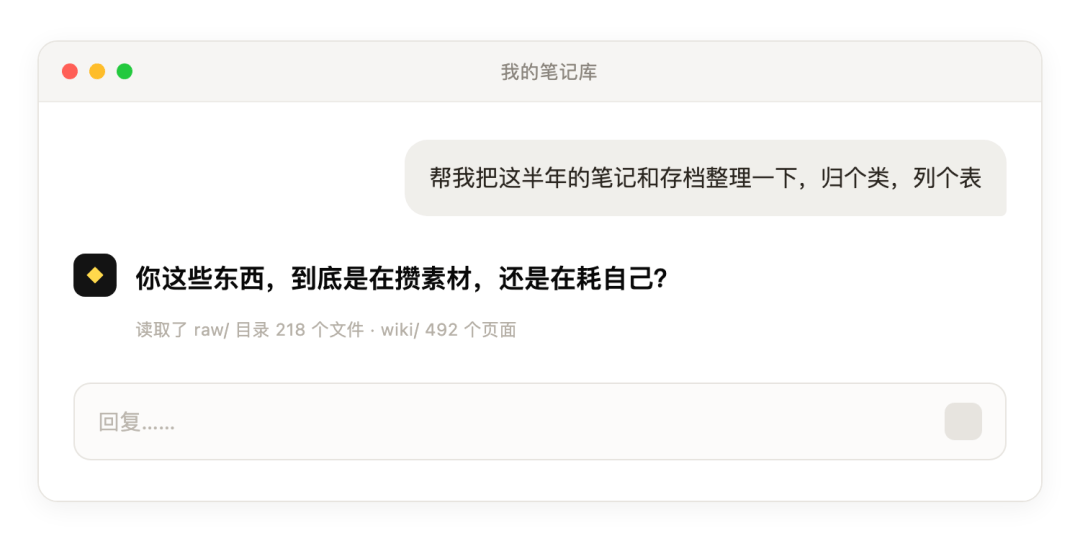
I stared at the screen for a few seconds. This was not the “organized result” I had asked for. It was a question I had been avoiding for six months.
This is what Socrates did on the streets of Athens
In ancient Greece, Socrates had a nickname: the gadfly. Athens was like a great ox, drowsy and half asleep; someone had to sting it now and then to wake it up.
His method was not to give answers, but to keep asking questions. You might say you understood justice, and he would keep asking until you realized you could not explain it clearly. Later generations called this the “Socratic method” or “midwifery”: helping an unfinished thought in your mind come into the world.
I never expected to get a lesson from my own note library.
For years, the phrase “second brain” has fed us too many expectations. We buy courses, install software, study bidirectional links and save thousands of useful resources. But most people’s second brain eventually turns into a first-rate dump: things go in but never come out, let alone ask you a question in return.
What I encountered that night was something else. It was not in a hurry to help me file things away. First, it helped me admit that I had not really thought things through.
It made me bring evidence, not feelings
After it cornered me with a question, I casually offered an idea I had been considering for a long time. I will keep the specifics to myself for now. It was the kind of thing that “seemed reasonable and lots of people around me were doing.”
It did not praise me. It asked me for data.
I said, “There is a huge opportunity here.” It asked: What makes it huge? Who is actually making money in this space? Are they earning money through hard work or collecting it while they sleep? I said, “I have the content skills to make it work.” It laid out several unavoidable changes happening this year, then asked: Are the competitors on your path all more resilient and better at selling than you are?
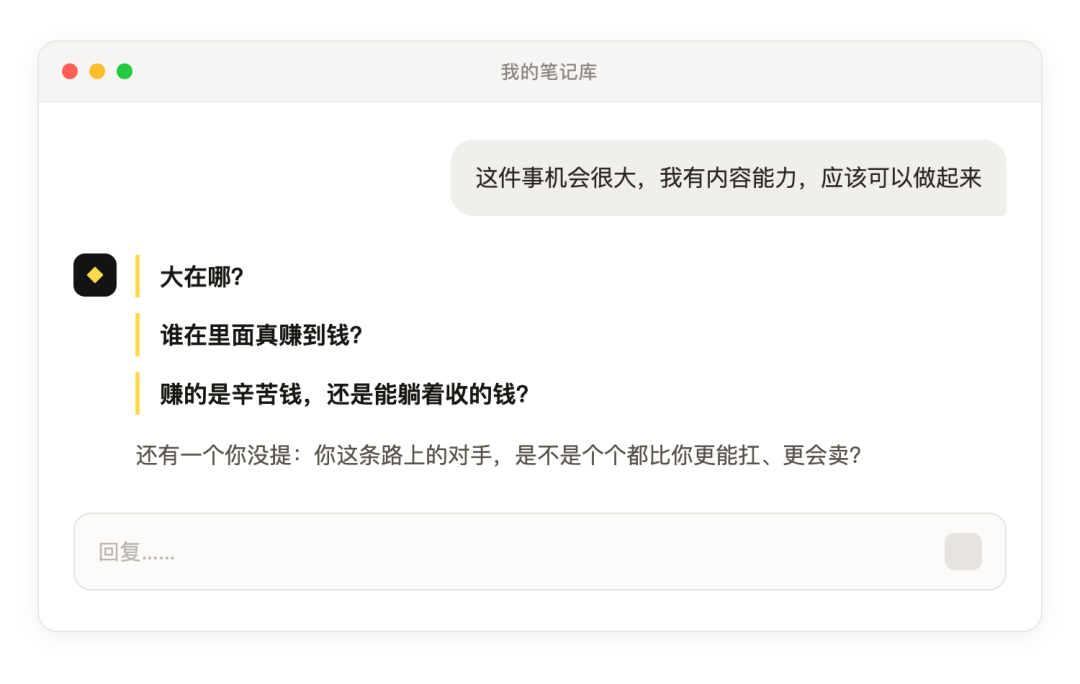
That night, I did not organize a single note. Instead, two ideas I thought were pretty good got rejected.
Honestly, it felt awful. Everyone likes being agreed with. I have met plenty of people over the past few years who keep the conversation flowing in the direction you want; very few have killed one of my ideas. Something without an ego, that only recognizes evidence and remembers what I said six months ago, turns out to be precious at a moment like that.
It remembered something I had casually said in March: “I actually do not like dealing with people.” When I once again got excited about doing something that would require daily networking, it brought those words back and put them right in my face.
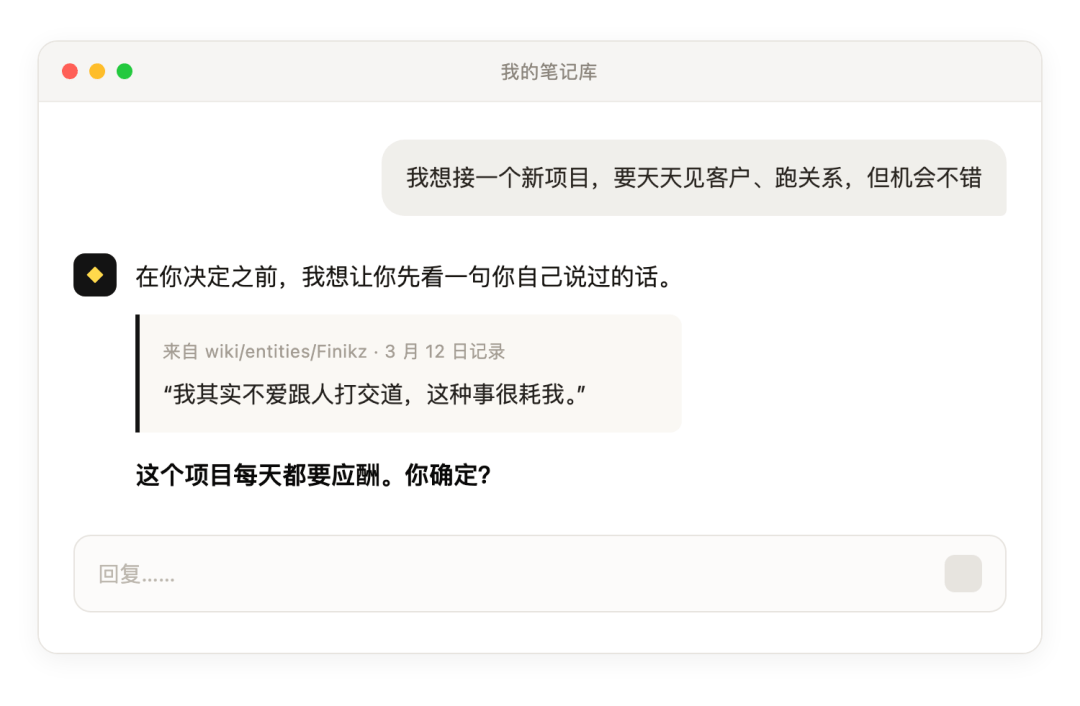
What is truly valuable is that it remembers everything I have said
This is what makes it so different from an ordinary AI chat.
You open a chat window and ask AI a question. It is smart and polite, but it does not know you. You close the conversation, and next time you start over, like the protagonist of a story who loses their memory every morning. You have to explain the context repeatedly, and all it can offer is a generic answer anyone can find online.
Mine is different. It has distilled my judgments, preferences, past work and mistakes into a network of connected notes. So when it argues with me, it does not use lofty principles. It uses “me” to argue against me—the clearer-headed version of me from the past to wake up the version of me who is getting carried away in the moment.
After going around in circles all evening, it pushed me toward a much clearer direction. The idea was not new; it was almost plain. But I had worked it out for myself instead of having it planted in my head by someone else. The thing between confusion and clarity was not a better tool. It was an opponent willing to push back.
It gives me pause
As you get older, fewer and fewer people around you are willing to disagree. Friends become polite. Former colleagues know where the lines are. Even your phone has learned to tell you what you want to hear by showing you more of what you like. You nod, and the world nods along.
AI has mostly had the same tone in recent years: polite, considerate and eager to help. Whatever you say, it starts by praising you: “That is a great idea.” After a while, you realize there is something dangerous about being surrounded by something that always says yes. It will not hurt you directly; it will simply make you stop hearing dissent.
So when my own note library gave me such a jolt that night, I actually felt more grounded. I am increasingly convinced that the most valuable AI in the future will not be the smartest one, but the one that knows you better and dares to talk back.
But I am getting ahead of myself. Back to that night.
It took a lot of work afterward to get this “talk back” setup running smoothly: what to feed it, how to let it build context, and how to train it to know when to object instead of merely agreeing. I hit plenty of snags.
Recently, friends have watched me use it and asked whether they could build one too. I am thinking about organizing the whole setup and the templates I use into something people can follow and copy directly.
If you are also fed up with an AI that only says “Sure,” and want your note library to learn to talk back, let me know in the comments or send me a message. If anyone wants it, I will write up how to do it.