The stronger AI gets, the busier we become. In the AI era, people have to learn how to work all over again.
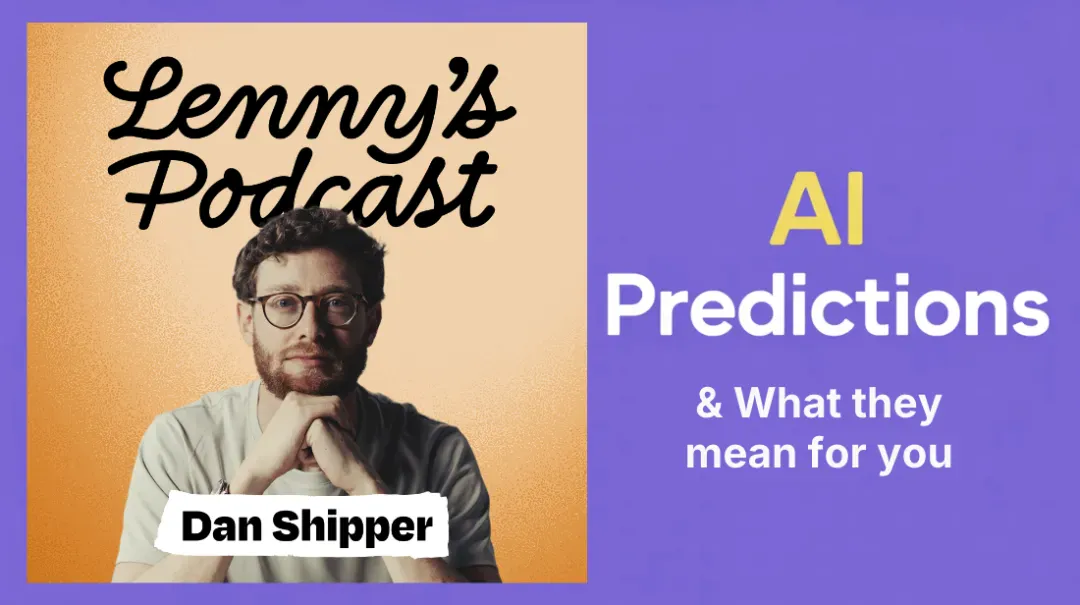
Dan Shipper recently joined Lenny’s podcast to talk about what work might look like in the age of AI.
This was not the kind of AI forecast delivered by someone standing safely on shore and commenting on the waves.
It felt more like someone who had already been soaked, turning around to tell us what the water is really like.
Dan had plenty of pointed predictions: the CLI era is ending, SaaS will survive, product managers and full-stack designers will thrive, every company will have a super-agent, and ordinary people should stop worrying and “ride the models.”
But one line made me stop: automation is a lie.
He does not mean automation is not real. We have misunderstood where it leads. We imagine automation means less work for people: machines take over, humans are freed, offices empty out and inboxes clear themselves.
It sounds lovely.
But what Dan has seen at Every is the opposite. The more work you automate, the more work appears. The more AI agents there are, the more people are needed. The more code, documents, analysis and design AI produces, the more someone has to step up a level and ask whether it is right, whether it is worth doing and whether it should be thrown out and rebuilt.
That is not AI getting weaker.
It is what happens when AI gets strong enough for the real substance of work to show through.
We have misunderstood “work”
Many conversations about AI and unemployment start with a simple model:
One job equals a set of tasks.
If AI can do those tasks, the job disappears.
That model is a little too much like Excel: neat, clean and easy to put in a presentation, but not much like the real world.
Real work is not a task list. It is more like a kitchen. You might think a chef’s job is to chop, cook and plate food. The hard part is judging the heat, coordinating the timing, figuring out why a customer is unhappy today and deciding whether a dish should come off the menu.
AI is very good at chopping ingredients, and it is getting better at cooking them.
But it is not very good at asking why we opened this restaurant in the first place.
Dan mentioned a test involving engineers. The scores of a new model had shot up, yet it still lost to a genuinely senior human engineer. The gap was not in fixing bugs. It was one level higher: a person can look at a pile of rotten code and say, “We should stop patching this. It needs to be rebuilt.”
That sounds like an engineering judgment. It is also a very human one.
In a lot of jobs, the most valuable thing is not carrying out a task. It is refusing to carry out the wrong one.
Once AI makes execution cheaper, judgment becomes more expensive.
Companies will start with a shared brain
Dan used to believe everyone would have their own AI agent. He has changed his mind.
He now thinks a company-wide super-agent is more likely to come first.
That shift is revealing. An AI agent is not a little toy you download and use right away. It is more like a living system that needs to be maintained. If personal agents keep making mistakes, need debugging, require permissions and have to understand context, most employees will give up.
It is not that people are not smart. Work is already exhausting; no one wants another temperamental electronic pet to look after.
A more realistic path is for a company to start with one shared super-agent inside a workplace such as Slack, maintained by a dedicated team. Team, department and personal agents can grow from there.
That creates a new kind of job: the forward-deployed engineer.
Companies used to hire engineers to build systems. They may soon hire them to look after a fleet of AI agents: connect them to data, fix their permissions, tune their workflows and clean up after the trouble they cause.
It is a little like what happened after the printing press appeared. Scribes did not remain mere copyists. People who understood writing, layout, distribution and what was worth printing became more valuable.
Many jobs will shift in the same way in the AI era.
You will no longer be valuable simply because “I can do this.”
You will be valuable because “I know whether this should be done, and how to get a machine to do it.”
Codex is not a tool. It is the new desk
Dan also believes that a lot of future work will happen in environments such as Codex, Claude Code and Co-work.
It is not AI being squeezed into SaaS.
It is SaaS being folded into AI.
We used to imagine AI at work as an AI added to Notion, another added to Gmail and another added to a CRM. Every app would grow a little assistant, like a row of salespeople waiting at a supermarket entrance.
Dan sees something more like this: you open an AI workspace with a browser that can see what you are doing, enter different SaaS products and help you work across them.
SaaS stops being a series of rooms you open one by one. It becomes a neighborhood the AI takes you through.
That is also why Dan thinks the CLI boom may be short-lived.
The CLI once made developers feel as if they were standing at the door to the future: black screens and white text, like hackers in a movie. But for most people, a GUI is not backward. It is a civilizational achievement.
If AI is really going to become part of ordinary work, it cannot live in the command line forever.
It has to enter the places where we actually work: browsers, desktops, email, spreadsheets, documents and chat windows.
To put it plainly, AI will not live only in the programmer’s basement.
SaaS will not die. It will have to open its doors again
“SaaS is dead” has been a popular claim over the past year.
The logic is straightforward: if AI agents can complete tasks directly, why do we need software?
Dan disagrees.
He even predicts the opposite: SaaS may get better.
AI agents will not only eliminate software. They will also become software’s new users.
Until now, a SaaS product has mainly served people. People click buttons, fill in forms, check reports and export data. In the future, it will have to serve two kinds of users at once: people and AI.
People need a web interface.
AI needs APIs, permissions, logs, rollback, approvals and synchronized state.
That will force SaaS products to redesign themselves. Adding a chat box in the lower-right corner is not enough. A truly AI-ready SaaS product must let a machine act on someone’s behalf safely, while allowing a person to take over, review and undo those actions at any time.
It does not sound glamorous.
But that is the real moat for enterprise software.
Companies are not most afraid that AI will be unintelligent.
They are afraid that AI will be very intelligent and then delete the customer data.
Old skills will get cheaper, but people will not disappear
Dan’s view of an AI jobs apocalypse is also counterintuitive.
He says an AI job apocalypse will not really happen.
That is not a pep talk. His reasoning is colder: models will make yesterday’s human skills cheap. Writing ordinary marketing copy, doing routine analysis, changing standard code and drawing conventional interfaces will all become commodities.
That stings a little, but the uncomfortable parts are often true.
The thing is, people will not stop there. Once old skills get cheaper, people will use them to create new things. As more new things appear, they bring new judgment, maintenance, taste, coordination and responsibility.
Then AI learns those new skills too.
And the cycle continues.
It brings to mind an old business lesson: higher efficiency does not necessarily reduce work. Often, it expands demand.
When printing made text cheaper, writing did not disappear. It gave rise to newspapers, novels, magazines, advertising, the internet and public accounts.
Cheaper skills do not mean humans leave the stage.
They raise the stage by one level.
Why product managers and designers may win
Dan is especially optimistic about product managers and full-stack designers.
I like this prediction because it gets to the real advantage in the AI era: the winner is not necessarily the person who writes the best prompts.
It is the person who knows best what should be built.
Every has a product manager who used to work on a writing product and knew a little about technology. With tools such as Cursor and Claude Code, they could almost lead a team and build the product themselves. Once AI filled in the implementation skills, product sense, user insight and timing suddenly became much more valuable.
The same is true for designers.
Many designers used to get stuck at implementation. They could draw something but could not build it; they had a strong idea but no room in the schedule; a tiny revision had to wait until an engineer was free.
As AI thins that wall, designers with real taste, product intuition and the ability to express an idea from start to finish will become formidable.
That does not mean every designer wins, or every product manager.
The winners will be people who can turn a vague desire into a clear product. AI can help with execution, but it cannot supply taste. It can generate a hundred options, but it does not inherently know which one will make a user’s eyes light up.
Taste is hard to measure.
And the harder it is to measure, the harder it is to replace completely.
Ordinary people should not panic. They should ride the models
Dan’s advice to ordinary people is to ride the models.
I like that phrase better than “learn AI.”
Learning AI sounds like signing up for a course, taking an exam and getting a certificate. It feels heavy and difficult, so it is easy to put off.
Riding the models is more like surfing. A new model arrives, and you hop on to see what it can do. Can it write an email for you? Organize a meeting? Fix some code? Research a topic? Move forward something you have been putting off?
You are not doing it to look cutting-edge. You are letting your body get used to the water temperature of the future.
Many people fear AI because they only see it in the news. News stories make AI sound terrifying: replacement, unemployment, layoffs, AGI, regulation, superintelligence.
But when you put AI into your own work, it becomes concrete. And once it is concrete, it is less frightening. It will do something stupid, take shortcuts and state nonsense with a straight face. Then, at some point, it will suddenly make you think: “Damn, that just saved me two hours.”
That moment matters.
People are not usually changed by fear.
They are changed by surprise.
The real question is not whether AI will replace you
After listening to this interview, I found myself thinking that “Will AI replace people?” is becoming a boring question.
It is too crude.
The real question is this: when AI makes the skills you were proud of yesterday cheaper, are you willing to move up a level?
You used to know how to write. Now you need to know what is worth writing.
You used to know how to make a presentation. Now you need to know whether the meeting needs a presentation at all.
You used to know how to write code. Now you need to know whether that code should exist, or whether the whole product logic is wrong.
This is not easier work. It may be harder.
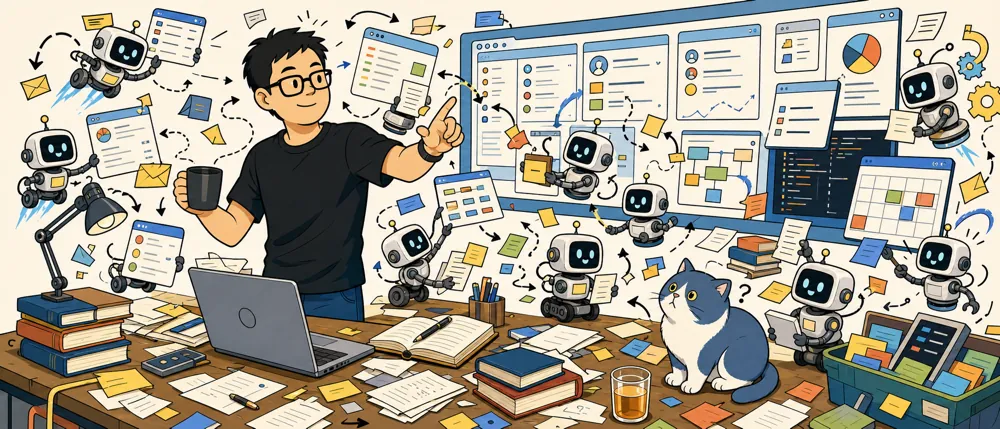
Dan says Every uses a lot of AI, yet the company has more people, and he himself works longer hours. There is a dark sort of humor in that. But it may be what future work really feels like: people are not sitting in the shade watching machines toil. They are at a noisier command station, facing more possibilities, more output, more decisions and more responsibility.
Automation has not made work disappear.
It has reshuffled what counts as work.
I do not think this is purely good news. It will make many skilled people feel less secure, and leave people who do not want to think with nowhere to hide.
But it will also create new opportunities.
People with judgment, taste and curiosity who are willing to get involved will suddenly find themselves leading a team that is noisy, fast and unstable, but can get things done.
You do not have to like it.
But you had better learn how to direct it.
I write about AI, culture, going global and everything else that catches my interest. If you enjoyed this, please like, share and save. Thanks for reading. See you next time!