Have you ever seen a line of trucks stretching for several kilometers?
That is what recently happened outside Yaoming Sugar Factory in Huazhou, Maoming. Trucks loaded with fruit cane from other parts of the country were lined up bumper to bumper for kilometers. Some drivers had to wait two or three days to unload. The factory owner, Chen Yao, arranged for staff to bring them three meals a day, hot water and portable toilets. Later, he issued a notice: trucks waiting more than 24 hours would receive a queueing allowance of 10 yuan per tonne. The factory stayed open through the May Day holiday, running three shifts around the clock. Chen gave every employee a 500-yuan holiday bonus. There was only one goal: help the cane farmers get their crop crushed as soon as possible.
Online, people started calling it “the warmest sugar factory on the internet.”
When I saw the story, my first reaction was not to feel moved. I wanted to understand something:
How did all this sugarcane end up unsold?
First, that “legendary scene” at the universities
Go back two months, to March, when something unusual happened at universities across Guangzhou.
South China Agricultural University set up seven pickup points, with piles of cane stacked like little hills. About ten truckloads—30,000 stalks—arrived at two campuses of Guangdong University of Foreign Studies, which students nicknamed “the martial arts tournament.” South China Normal University distributed a full 100 tonnes at once.
The campaign was organized by the agriculture and rural affairs bureau of Nansha District together with the local supply and marketing cooperative. It was called “A Million Talents Gather in South Guangdong: A Thousand Tonnes of Nansha Fruit Cane for Students and Medical Workers.” In total, nearly 1,000 tonnes of Nansha fruit cane went to universities, medical workers and education staff.
After word got around, students at universities that had not received any cane started calling out: “Does Sun Yat-sen University not like sugarcane?” “Does South China University of Technology not like sugarcane?” The Nansha government played along and announced more deliveries to Sun Yat-sen University, South China University of Technology, Jinan University and others.
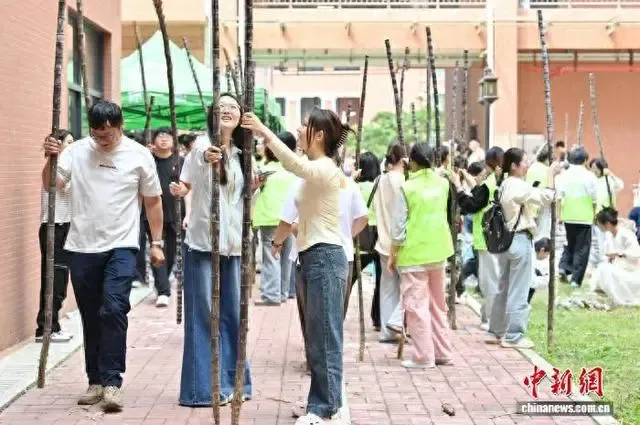
On the surface, this is a heartwarming story about a government responding to people and universities working with their local communities. But think one step further: a government office went to great lengths to send a thousand tonnes of cane to universities because even more cane could not be sold.
This was not a benefit program. It was a rescue operation.
Why is this year’s sugarcane so hard to sell?
The reason is not complicated, but every time it happens, it is painful to watch.
In 2024, fruit-cane prices in Guangdong were good. They reached about 1 yuan per jin—roughly 500 grams. By one rough estimate, after costs, a mu of cane could net around 10,000 yuan. That was not a bad return in today’s agricultural economy. Once word spread, many farmers expanded their planting. One grower, Chen Weiguang, had previously grown corn, grapes, citrus and bananas. In 2025, betting on the market, he invested more than 20 million yuan, rented 2,400 mu of land—about 160 hectares—and planted all of it with sugarcane.
The problem is that he was not the only person who thought that way.
Around the 2026 Lunar New Year, large quantities of new cane came onto the market. Supply and demand shifted sharply, and prices began to collapse. Farmers thought, “Prices will rise after the New Year,” so they held back their crops instead of selling. The longer they waited, the further prices fell. By the time they reacted, the stalks were starting to fall over. If they did not sell soon, the cane would rot in the fields.
Making matters worse, demand for fresh cane normally falls after the holiday. Supply also rose at the same time across all the producing regions. Sugarcane is not exactly a staple, and other seasonal fruits took away even more of its market.
Caught between those two forces, a glut was almost inevitable.
Where have I seen this story before?
In Xuwen.
In 2018, pineapples in Xuwen County, Zhanjiang, Guangdong, suffered a severe glut. Xuwen is China’s largest pineapple-growing region: one out of every three pineapples in the country comes from there. That year, more than 100,000 mu of the crop could not be sold. At the lowest point, no one would buy them even for 0.2 yuan per jin—about 500 grams. “A disaster” barely describes the pineapples rotting in the fields.
The cause was almost identical: pineapple prices had been good in the previous years, so farmers followed the trend and expanded their acreage. Production surged, the market could not absorb it and prices collapsed.
This year’s fruit-cane glut is also substantial. Nansha District alone produced about 290,000 tonnes in 2025, and roughly 40,000 to 50,000 tonnes were still waiting to be sold after the 2026 Lunar New Year. Yaoming Sugar Factory alone expects to process more than 100,000 tonnes. There is not yet a unified estimate for the overall glut across Guangdong, Guangxi and other provinces.
Pineapples and fruit cane are different crops, but the underlying reason for the glut is the same: information is unevenly distributed, and decisions depend on individual experience and last year’s prices. No system tells farmers, “This year, this many people across the province are growing this crop, and the market can absorb this much.” So everyone acts alone, and the whole group gets caught out.
This is the famous “pig cycle” in agriculture: prices rise, everyone rushes in; prices fall, everyone suffers; then the market clears itself and the next round begins.
How Xuwen’s pineapples found a way through
In 2019, the Guangdong Department of Agriculture and Rural Affairs issued a document supporting Xuwen’s experiment with a market system called “12221.” The name sounds like a code, but the pieces are simple:
- The first “1”: build one agricultural big-data system so production, prices and market activity can be checked in real time.
- The first “2”: form two teams—an alliance of buyers in consumer markets and local brokers in the producing region.
- The second “2”: develop two markets—deepen the market in the producing region and broaden access to consumer markets.
- The third “2”: organize two kinds of campaigns: “bring buyers in” to see the crop and “go out” to take Xuwen pineapples to large consumer markets.
- The final “1”: pursue a package of goals at once: build the brand, increase sales, guide the market, improve varieties and raise farmers’ incomes.
It may look like a standard set of government actions. The real insight is the change in the thinking behind it:
Move from “grow first, then find buyers” to “let sales guide production.”
The old agricultural logic was to grow a crop and then look for someone to buy it. The 12221 system first gets a clear picture of demand, then uses that information to guide what to plant and how much to grow. That change is fundamental.
During the pandemic in 2020, the head of Xuwen County joined livestream sales to help farmers, moving nearly 150,000 kilograms of Xuwen pineapples. After that, the “army of pineapple growers” gradually became an “army of pineapple sellers.” By 2023, the annual output value of Xuwen pineapples had risen from 980 million yuan in 2018 to 2.5 billion yuan. The region had enjoyed five consecutive years of good harvests and sales.
Can fruit cane follow the same path?
In theory, yes—but there are a few difficulties.
Pineapples have a natural advantage: they can be processed. Small or lower-grade pineapples can be cut into ready-to-eat fruit, or turned into pineapple mooncakes, grilled fish with pineapple, rice cakes and more. Processed products extend the supply chain and reduce the pressure when fresh fruit cannot be sold.
Fruit cane is not so easy. It is grown to be eaten fresh. It is juicy and has soft fibers, so it is meant to be eaten directly. It has a short shelf life, does not travel well and is expensive to process. Yaoming Sugar Factory’s decision to buy fruit cane and crush it for sugar was an emergency measure. Its owner, Chen Yao, admitted that the factory may lose money. This is not a sustainable path to industrial-scale growth.
The way people consume it is another problem. Pineapples can be cut up and sold almost anywhere; they are easy for young people to buy and eat. But how many people do you know who peel sugarcane at home? For urban consumers, cane still means street-side sugarcane juice or a New Year ritual. It has very little place in everyday life.
But that is precisely why fruit cane needs a 12221 system—and an upgraded version that is more ambitious than the one for pineapples.
Pineapples broke through because of the potential of the crop itself. Once more people knew about Xuwen pineapples and could buy them, the market could absorb most of the supply. Fruit cane has to solve another problem besides distribution: it has to create new occasions for consumption. People need to be able to buy freshly pressed cane juice at convenience stores, order drinks made with cane syrup at milk-tea shops and get peeled or cut pieces of cane from grocery apps. That requires coordination across the entire supply chain.
What can AI do here?
This is the part I most want to talk about.
At its core, the 12221 system is an information system plus a coordination mechanism. Its limits are that people report the data manually and late; supply-and-demand matching relies on experience and relationships and is rough; and price warnings are usually retrospective, making it hard to forecast trouble in advance.
AI could help make the system actually run.
Layer one: give farmers an early warning.
Right now, growers decide what to plant based on last year’s prices, what their neighbors say and their own intuition. It is a decision made with extremely limited information. An AI system could combine acreage data from across the province, consumption trends up and down the supply chain, weather forecasts and historical price cycles, then warn farmers before the planting season begins: this year’s fruit-cane supply across the province is projected to exceed market demand by 30%; consider planting less.
If this step worked, the glut would never happen in the first place.
Layer two: match supply and demand in real time.
Now, when farmers cannot sell their cane, they do not know where to find buyers. Yaoming Sugar Factory may have hundreds of trucks arrive, without knowing who is coming, when they will arrive or how long they will wait. This is a two-sided information mismatch. AI could match supply and demand in real time: farmers report their inventory, buyers report what they need, and the system calculates efficient routes. Hundreds of trucks lined up for kilometers could become an orderly logistics network.
Layer three: activate new ways to consume it.
Fruit cane’s biggest problem is that it has too few consumption occasions. AI-generated content and targeted distribution could help open up the market.
Imagine that, during this year’s harvest, Xiaohongshu and Douyin are suddenly filled with videos and posts about ways to eat Guangdong sugarcane: pork ribs braised with cane, water chestnut and cane drink, homemade brown-sugar lattes. This would not mean paying subsidies to buy traffic. AI could analyze what content works on which platform and with which audience, then distribute it precisely. Activating those consumption occasions could turn fresh-eating cane from a holiday symbol into an everyday product.
This is not fantasy. Xuwen’s “AI Pineapple” initiative is already moving in this direction: integrating data into the entire agricultural process so livestreams, short videos and new forms of e-commerce can genuinely connect production with sales.
But I want to make a more fundamental point:
The value of 12221 is not a tool. It is a shift in the way we understand the problem: treating agricultural problems as information problems. Upgrading the system with AI means putting that framework into practice faster, more accurately and at greater scale.
It cannot solve human nature.
Chen Weiguang saw the good market in 2024 and went all in on 2,400 mu of sugarcane. That shows the issue is not only whether data is available. It is also about farmers’ expectations, their tolerance for risk and the market cycle that an individual grower cannot control. AI can tell him, “The area planted across the province has already exceeded the historical peak,” but it cannot stop him from thinking, “This year feels different.”
“Smooth as a stalk of cane”
In the most prominent place in his factory, Yaoming’s Chen Yao has hung a line: “Without cane, there is no factory; the factory and the farmers are one family.”
Around 1995, Chen took over the Huazhou sugar factory, which was close to going bankrupt. It eventually survived by deeply connecting the business with cane farmers through a “family farm” model that leased plots of land to them. Thirty years later, after seeing cane farmers in Zengcheng lamenting their situation, Chen rushed back to Huazhou that night. The next day, he called a meeting and made the call: no one would be turned away; the factory would buy it all.
This is one specific person doing one specific thing.
But I hope that one day this will not require a “kindhearted sugar-factory owner” to step in during a crisis. The whole system should be able to sense trouble early, redirect production and activate the market before it happens.
The factory’s kindness treats the symptoms. Building data and mechanisms is what treats the illness.
“Smooth as a stalk of cane”—in Cantonese, this means things are going well, everything is fine.
I hope every cane farmer gets to see the crop through smoothly.
One more thing
The personal reason I wrote this.
I am from western Guangdong. I have eaten sugarcane since I was a child, so I feel a natural fondness for it. I also recently finished translating a set of books called The Dionysus Trilogy, about the stories of wine, beer and rum.
Rum is distilled from sugarcane. The books also describe how sugarcane was domesticated from a wild plant and turned into a source of sugar. I did not expect that a few months after reading about it, I would see sugarcane making the news in Guangdong.
By the way, The Dionysus Trilogy is expected to go on sale in June. I will say more about it then.