What I Know About China’s “Front Wave” and “Back Wave”
A viral Bilibili speech about the “younger wave” moved many people in the “older wave” generation. They shared and liked it on their social feeds, as if they had to ride the next wave now or be washed up on the internet’s shore.
Many people in the older wave had never heard of He Bing either. There seem to be several middle-aged actors like him, and even the size of their eye bags is not much help in telling them apart.
It is easier to take the speech in stride if you see it as an ad trying to get middle-aged and older people onto Bilibili. Sure enough, the video gave Bilibili’s share price another lift. And the company was due to report earnings on May 11. No wonder!
In fact, Lu Xun also praised the younger generation in his day. He wrote:
“I have always believed in evolution, and used to think that the future would inevitably surpass the past, and the young would surpass the old. I respected the young so much that I could hardly do enough for them; if one struck me ten times, I would return only one blow. But later I realized I had been wrong. It was not any theory of historical materialism or revolutionary literature that misled me. In Guangdong, I witnessed young people split into two camps: some sent denunciations and informed on others, while others helped the authorities arrest people. The experience shattered my thinking. Ever since, I have often looked at young people with suspicion and no longer revered them unconditionally.”

By national standards, many people in the older wave are no longer young. But by world standards, perhaps they can keep riding the waves for a few more years.
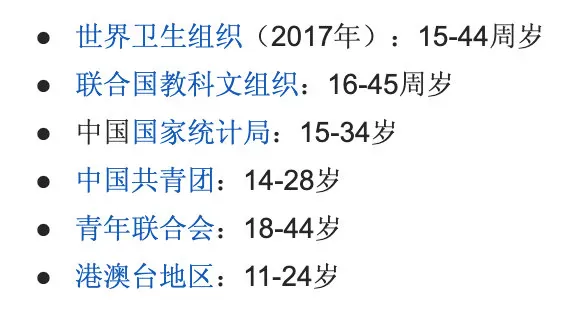
So it is no surprise that so many Schrödinger’s “older wavers” got excited on social media: they had been observed!
Back to the point.
If you have ever bought trousers on Taobao, you may have seen a chart like this on a product page:
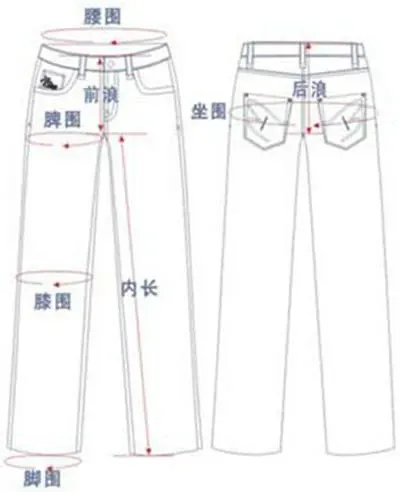
Sizing charts often list the “front rise” and “back rise.” Do they make you feel like belting out the theme song from The Bund: “Waves roll in… waves roll out…”?
Then one day, after finally bridging the Cantonese–Mandarin divide, I had an epiphany: “rise” here means the crotch—the Cantonese term fu long for the trouser crotch.

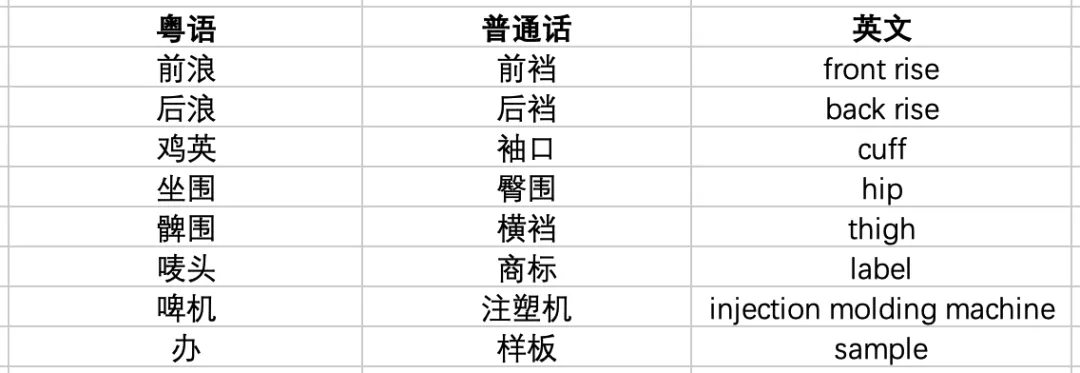
In other words, “front rise” and “back rise” are Cantonese terms that have entered Mandarin, much like díshì (“taxi”). Their use is confined to the clothing industry, though; they never caught on as widely as díshì, which displaced the Mandarin term for taxi.
Industries such as garment-making, mold-making, and injection molding developed through a transfer of production from abroad to Hong Kong, then Guangdong, and finally the mainland. As a result, they acquired two sets of terminology: Hong Kong/Taiwan usage and mainland usage, or Cantonese and Mandarin.
Mold-making terms in particular may have three Chinese versions. The same component or process can have different names in Hong Kong, Taiwan, and mainland China.
Even people in the same trade can talk past one another: put a Guangdong factory owner in a meeting with someone from Jiangsu or Zhejiang, and it can be like chickens talking to ducks. Here are a few examples of just how far apart the “chickens” and “ducks” can be:
I remember when I was still part of the younger wave, accompanying my boss—a French Chinese man—to a mold factory in Panyu, Guangzhou, run by a Hong Konger. We were meeting French clients to discuss a possible partnership. The host, Mr. Xie, was Hakka from Meizhou; both his Cantonese and Mandarin had a strong Hakka accent. (I can understand a little Hakka myself.)
I have never forgotten what interpreting that meeting involved:
- First, I “translated” Mr. Xie’s Hakka-accented Mandarin into standard Mandarin for my boss.
- Then I translated what he said into French for the clients and my boss.
- At the same time, I converted mold-making terms between Cantonese, Mandarin, and French.
- For the terms I was unsure how to translate, I had to fall back on English. …
As manufacturing moved elsewhere, Cantonese terminology gradually faded. Even in Guangdong, it is increasingly being replaced by standardized Mandarin terms. The people who hold technical expertise and influence over terminology are no longer Hong Kong masters, but university and vocational-school instructors.
And wave after wave of younger manufacturing workers have moved on to Southeast Asia and Africa—which is why Zhu Yidan never runs out of Africa jokes…
Scan the QR code on the original page to support the author.