The Spa Town
“Autumn came. In the pleasant valley, the leaves turned yellow, red, and brown. The little spa town looked as if it were wrapped in flames.” — Milan Kundera, The Farewell Party
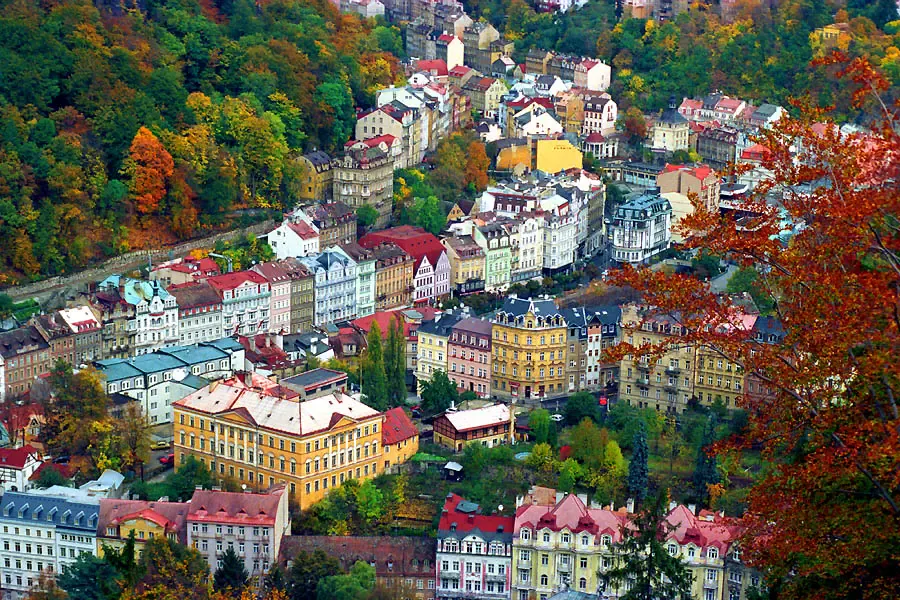
Karlovy Vary
Karlovy Vary lies 120 kilometers west of Prague, the Czech capital. In the fourteenth century, Charles IV, Holy Roman Emperor and King of Bohemia, discovered its hot springs while hunting deer. He built a town there as a royal spa.
From the sixteenth century onward, Karlovy Vary became one of Europe’s best-known spa towns. Many cultural figures visited or came to take the waters, including Karl Marx, Peter the Great, Pushkin, Goethe, Schiller, Beethoven, Chopin, and Gogol. The town’s artistic character took root early.
Karlovy Vary International Film Festival
Karlovy Vary’s connection with cinema dates back to the earliest days of film. In 1896, some of the world’s first films, made by the Lumière brothers and Thomas Edison, were screened in the Czech cities of Prague and Karlovy Vary.
The Karlovy Vary International Film Festival is one of five major international festivals recognized by the International Federation of Film Producers Associations, alongside Venice, Cannes, Berlin, and Montreal. It was founded after only Venice (1932) and Cannes (1939). In 1946, the year after World War II ended, a group of filmmakers who had been active before the war established the festival in Mariánské Lázně, Czechia. The first edition was noncompetitive and screened films from seven countries. The second moved to nearby Karlovy Vary, where it has been held in the first half of July each year ever since.
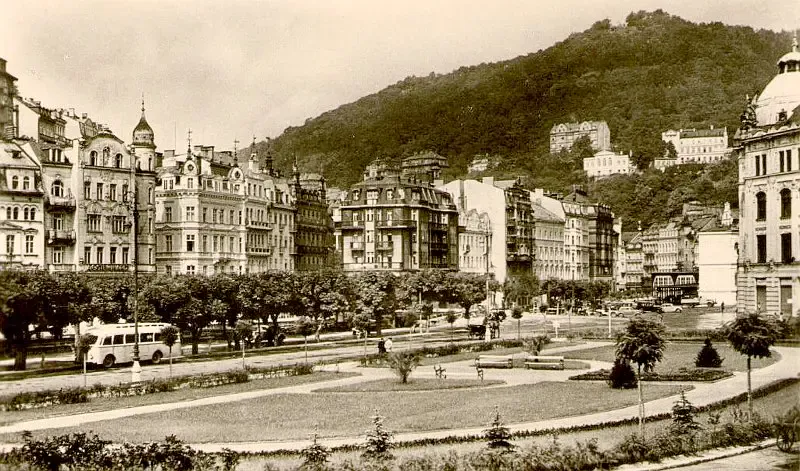
In February 1948, Czechoslovakia’s Communist Party came to power, and the festival came under the country’s state film department. For decades, Karlovy Vary became a tool for the communist bloc to compete with the West in cinema, particularly with Venice and Cannes. Film selection, awards, and guest invitations all had to serve communist propaganda. Most of the major prizes went to films from socialist countries.
The festival was held every year from 1946 to 1958, except in 1953 and 1955. The Soviet Union launched the Moscow International Film Festival in 1959. The International Federation of Film Producers Associations, then dominated by the Western bloc, required Moscow and Karlovy Vary to alternate, so Karlovy Vary became biennial until it returned to an annual schedule in 1994.
In the 1960s, Czechoslovakia entered an ideological “thaw,” and the Czech New Wave emerged. Many outstanding Czechoslovak films screened at Karlovy Vary and won acclaim at Western festivals such as Venice and Locarno. A number of notable Western films also appeared at Karlovy Vary.
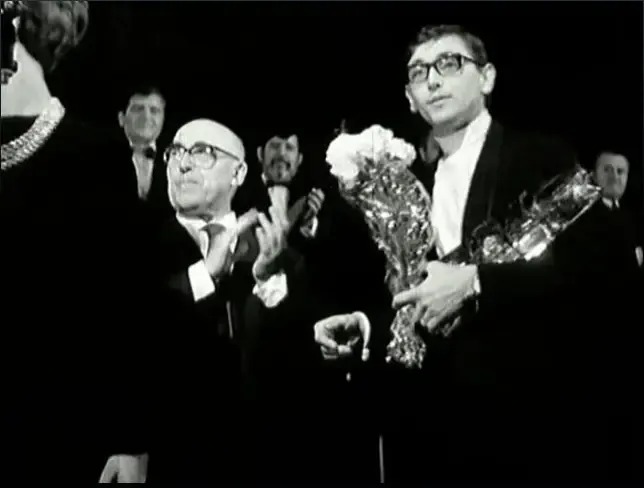
The 1968 festival opened during the Prague Spring. The spirit of reform shaped the festival rules too: there was no official jury; instead, three international juries judged creativity, performance, and technical achievement separately. Czech New Wave director Jiří Menzel won the top prize, the Crystal Globe, for Capricious Summer. His Closely Watched Trains had just won that year’s Academy Award for Best Foreign Language Film.
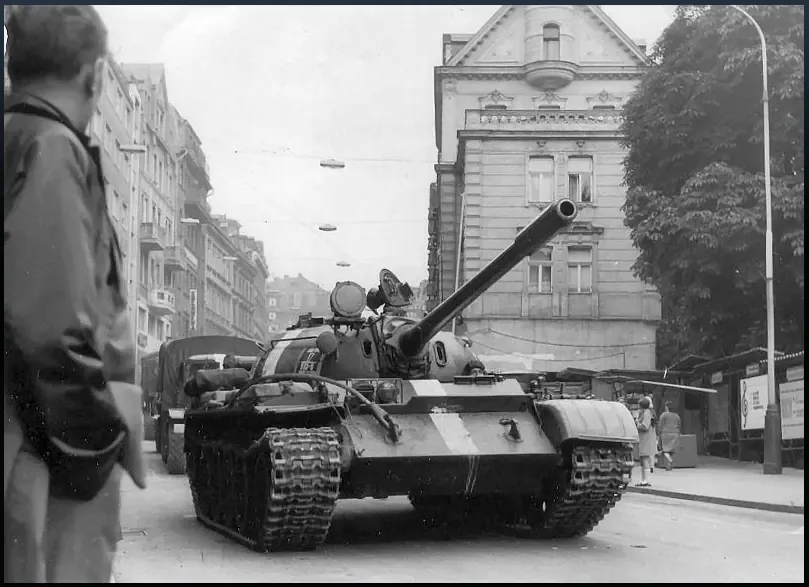
But the thaw did not last. On August 20, 1968, Soviet forces invaded Prague; the next day they occupied all of Czechoslovakia. Karlovy Vary remained open to films from around the world, but in the 1970s and 1980s, almost all its prizewinners came from communist countries. One notable exception was the 1988 festival, when Chinese director Xie Jin won the Crystal Globe for Hibiscus Town.
The festival operated under political pressure for forty years and struggled for several years even after the Velvet Revolution of 1989. At the 1990 festival, several Czech films that had previously been banned were finally allowed to screen. The public showed little interest, however, and the event could not shake its reputation, tarnished over decades.
In 1994, actor Jiří Bartoška and film journalist Eva Zaoralová took over the festival’s organization. They set out to turn it into an international film forum that the world would want to attend. The participation of prominent international filmmakers in the following editions helped restore its profile, especially that of Czech director Miloš Forman (The Firemen’s Ball, One Flew Over the Cuckoo’s Nest, and Amadeus), who had been forced into exile in the United States after the Prague Spring. Bartoška and Zaoralová gradually established new programs and an updated structure. Within a few years, the festival had regained its international reputation and won back filmmakers and audiences.
Main Festival Programs
- Competition of Feature Films: Feature films submitted to the festival compete; none may have screened at another international festival.
- Documentary Film Competition: Two categories: short documentaries of up to 30 minutes and feature documentaries over 30 minutes.
- Horizons: New films from different regions, alongside prizewinners from other festivals.
- Another View: Experimental and unconventional films.
- Forum of Independents: Independent films from around the world.
- East of the West: Films from former socialist countries.
- Czech Films: A look back at Czech films from the previous year.
- Retrospectives: Programs devoted to internationally influential filmmakers, particular genres or eras, or films selected according to a chosen theme.
Main Competition Awards
- Grand Prize — Crystal Globe: $30,000
- Special Jury Prize: $20,000
- Best Director
- Best Actor
- Best Actress
- Best Documentary Film, up to 30 minutes
- Best Documentary Film, over 30 minutes
- Crystal Globe for Outstanding Contribution to World Cinema