Last week, while translating exhibition materials, I came across several excerpts from essays by Xu Hong, a Chinese art critic. The materials were in English, and I wanted to translate them back into Chinese, so I went looking for the original instead of making something up.
This essay, “Out of the Abyss: A Letter to Women Artists and Women Critics,” was published by Xu Hong in Jiangsu Pictorial in 1994. It is widely regarded as China’s first feminist art manifesto and a foundational work of Chinese feminist art criticism.
But after trying Google and Baidu web search, academic search, digital libraries in Shenzhen, Zhejiang and Jiangsu, as well as CNKI and Superstar, I found plenty of papers citing the essay, but not the full text itself.
Fortunately, the magazine still exists, though it has been renamed Huakan. I found its accounts on Weibo and WeChat and left them messages. That same day, an editor replied that the 1994 issues had not yet been digitized. They asked a colleague to look for the print copy in the warehouse and take photos for me.
This morning I received the email. My sincere thanks to everyone at Huakan! It happens to be International Women’s Day. This important historical document deserves to be shared.
Happy Women’s Day to all women!
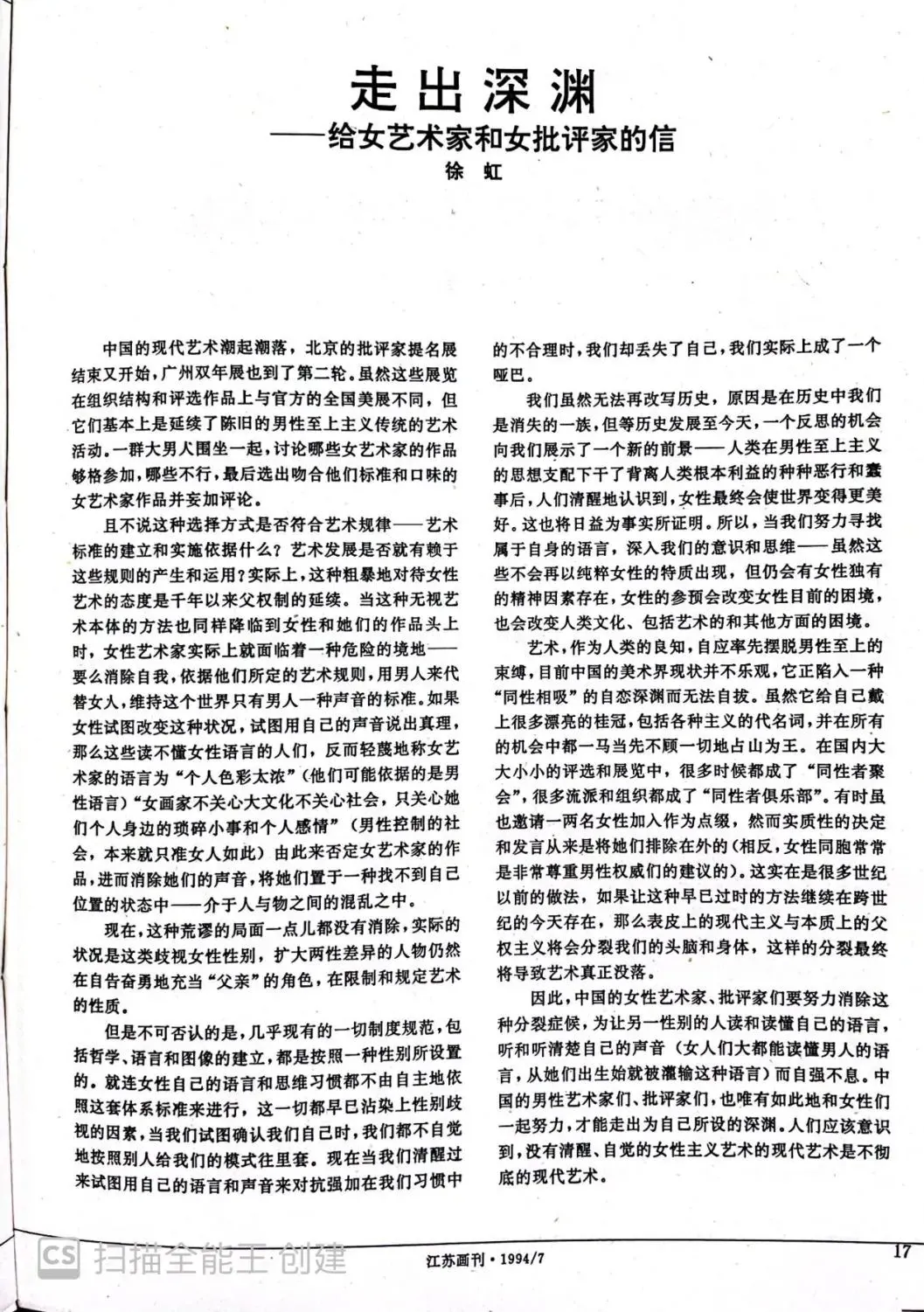
Out of the Abyss
A letter to women artists and women critics
Xu Hong
Jiangsu Pictorial · July 1994
Modern art in China has risen and ebbed. A critics’ exhibition in Beijing has just ended, and another has begun; the Guangzhou Biennale is now in its second round. Although these exhibitions differ from the official National Art Exhibition in their organization and the way works are selected, they largely continue the old, male-supremacist tradition in art. A group of men sit around discussing which women artists’ work qualifies for inclusion and which does not. In the end, they select the work of women artists that fits their standards and tastes, then pass judgment on it.
We can set aside the question of whether this method of selection follows any principle of art. What are the standards of art based on, and how are they established and applied? Does the development of art depend on creating and applying such rules? In reality, this crude treatment of women’s art continues a patriarchy that has lasted for thousands of years.
When this approach—one that ignores art itself—is imposed on women and their work, women artists face a dangerous choice. They can erase themselves and follow the artistic rules set by men, allowing men to stand in for women and preserving a standard in which the world has only one voice: men’s. Or, if women try to change the situation and speak the truth in their own voices, people who cannot understand women’s language dismiss it as “too personal” (perhaps judged against a male language). They say women painters do not care about the larger culture or society, only the trivial details of their personal lives and feelings—as if a male-controlled society had allowed women any other subject. They use these judgments to deny women artists’ work and silence them, leaving women without a place of their own, caught in a confusion somewhere between person and object.
This absurd situation has not disappeared at all. People who discriminate on the basis of sex and exaggerate the differences between the sexes are still volunteering to play the role of “father,” restricting and defining the nature of art.
Yet it cannot be denied that almost all existing norms and institutions—including philosophy, language and image-making—have been established according to one gender. Even women’s own habits of language and thought unconsciously follow those standards. They have all long been tainted by sexism. When we try to affirm ourselves, we unconsciously fit into patterns other people have given us. Now, when we wake up and try to use our own language and voices to resist the irrationality imposed on our habits, we find that we have lost ourselves. We have, in effect, become mute.
We cannot rewrite history, because throughout it we have been a people who disappeared. But now, as history reaches the present, an opportunity for reflection opens a new prospect before us. After humanity, under the control of male-supremacist thought, committed countless acts and follies against its fundamental interests, people are coming to recognize that women can ultimately make the world better. The facts will increasingly prove this. As we work to find a language of our own and explore our consciousness and thought, our voices will not emerge as purely feminine qualities, but they will still carry a distinct feminine spirit. Women’s participation will change their present predicament and also the predicament of human culture, including art and other fields.
Art, as humanity’s conscience, should be the first to free itself from male supremacy. The current state of Chinese art is not optimistic: it is trapped in an abyss of narcissism and “same-sex attraction.” It crowns itself with many fine-sounding labels and names of artistic movements, and seizes every opportunity to establish its dominance. In art competitions and exhibitions of all sizes across the country, many events become “gatherings of the same sex,” and many schools and organizations become “same-sex clubs.” Sometimes one or two women are invited as decoration, but they are always excluded from substantive decisions and discussion. (Women, by contrast, often show great respect for the advice of male authorities.) This practice is centuries old. If such an outdated method is allowed to persist into the new century, the split between modernism on the surface and patriarchy at its core will divide our minds from our bodies—and that division will ultimately lead to art’s true decline.
Therefore, women artists and critics in China must work to overcome this split, so that people of the other sex can read and understand our language, hear and listen clearly to our voices. (Most women can understand men’s language, since they have been taught it from birth.) Male artists and critics in China must work alongside women to escape the abyss they have made for themselves. People should understand that modern art without a conscious, self-aware feminist art is not fully modern art.