Last night, before bed, I was scrolling through Moments and suddenly felt that something was off. Half the people were posting results from a test with huge headline-style labels: “Dead,” “Monkey” and “Useless.”
I opened one and got “IMFW: Useless.”
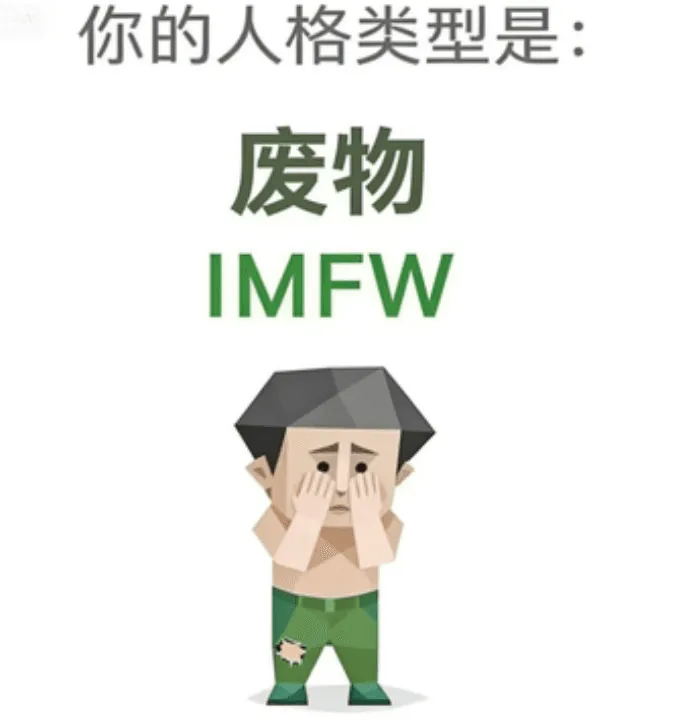
One line on the result page made me laugh: “Give a useless person a piece of candy, and they will give you a pair of sparkling eyes that trust you completely.”
That may be the most comforting insult I have heard this year.
How did a personality test become a phenomenon?
SBTI stands for Silly Big Personality Test.
Its origin story is unexpectedly sweet. A Bilibili creator who goes by Qu Rou’er Chuan’er made the test to persuade a friend who drank a lot to quit. In a video, she tricked him by saying it was the “official SBTI.” Halfway through, he was still complaining that it was nonsense. Then he got the “Alcoholic” personality—a hidden type triggered only by choosing “I enjoy drinking.”
The results page listed the health risks of alcohol. After reading them, her friend was quiet for a while and said, “That’s terrifying. Did my mom get to you?” In the end, he agreed to quit drinking.
The video was posted at 11 a.m. on April 9. It passed three million views in a day and was reposted 110,000 times.
I looked into it and found that the test’s algorithm is actually quite simple. It is a single HTML file. It breaks personality into 15 dimensions, asks 31 multiple-choice questions, then compares your responses with 25 preset personality types and returns the closest match.
But the labels are not respectable ones such as “Architect” or “Mediator.” They are “Dead,” “Alcoholic,” “Monkey” and “Useless.”
That is why it blew up overnight.
Why do we need to be insulted?
After taking the test, I kept thinking about one question: why are so many people lining up to be labeled “useless”?
Open any social media platform and everyone is praising you. AI says, “You have great insight.” Short videos recommend, “You deserve better.” MBTI tells you that you have a rare personality found in only 2% of the world.
It all sounds nice, but it gets so nice that you stop believing it yourself.
Caishaitou once wrote an article called “AI Is a Flatterer,” and he was right. Ask AI, “Is my colleague targeting me?” and it will build a case for why your colleague is a bad person. Ask, “Should I quit my job?” and it will always model the question from your point of view.
The answer was not given by AI. You had already decided it. AI just printed out your bias for you.
But if every AI is busy flattering us, how did SBTI get a tidal wave of traffic by insulting people?
I think the biggest difference between MBTI and SBTI is this: MBTI is a beauty filter that makes you feel attractive. SBTI is like your front-facing camera: it shows you what you look like, and you burst out laughing.
The first makes you think you are thinking. The second lets you know you are losing it.
Knowing you are losing it feels a lot better than having AI prove you are right.
A real story helped me understand
A friend got “SHIT: Cynic.” Its motto was: “This world is one big pile of shit.”
The personality description was perfect: they say the world is one big pile of shit, then get up at seven the next morning, squeeze onto a shit-tier subway and go to a shit job.
My friend sat quietly for a long time, then messaged me: “That is painfully accurate.”
I think it describes all of us. We ask AI, “Is my colleague targeting me?” or “Should I quit my job?” Then the next morning, we still get up at seven and go to work.
The problem is not that we need an answer. We need permission to complain for a moment.
AI helps you turn a complaint into a tightly reasoned manifesto. SBTI just says: fine, you are a “SHIT: Cynic”—you complain all day, but your hands keep doing what they have to do.
You do not need to write a 500-word midnight reflection to ask for help. You do not need to pose a leading question to AI—“Am I just exhausted?”—and get a warm piece of nonsense back.
An absurd label says the thing you cannot bring yourself to say.
What does it give us?
There is a detail on the SBTI test page that I like. Beside the progress bar it says “0/31,” with a line below: “The world is chaotic enough. At least finish the questions.”
That moved me a little.
We are almost losing the patience to finish 31 questions. We already know what we want the answer to be before asking AI. We swipe away from a short video if it fails to entertain us in three seconds. We never read past the first line of a long post in Moments.
But this test says: the world is chaotic enough—just finish the questions.
One person used AI to make SBTI, and the server crashed three times. Another asked AI to prove that “my colleague is definitely targeting me,” then went to bed feeling satisfied.
The tools were identical. What separated them was not who knew how to use AI better. It was who was still willing to hear something they did not want to hear.
AI’s problem is not that it is too smart. It is too considerate.
A friend who always says “You’re right” and an AI that always says “You’re right” differ only in that the latter will not stop you when you are drunk.
SBTI will. It will label you “DRUNK: Alcoholic.”
Like the best friend you had at school, who never said, “You’re amazing.” They just said, “Are you stupid?” and then lent you their notes.
What I learned from SBTI
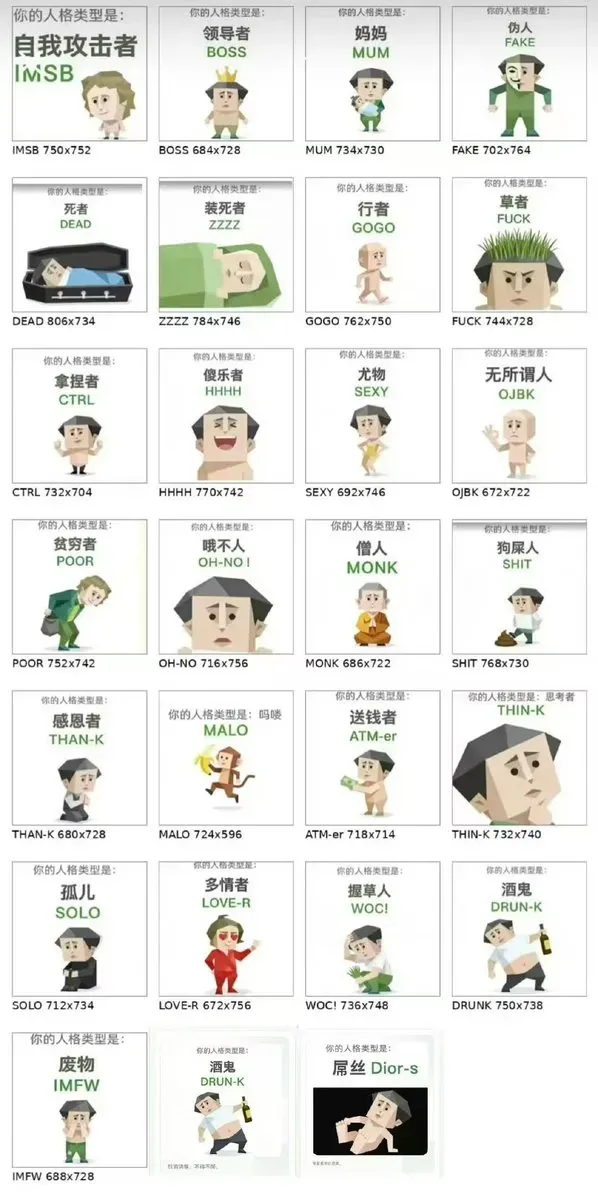
SBTI’s technical implementation is not complicated. One HTML file, a simple algorithm and 27 personality templates, with no backend and no training set. In 2026, anyone could make the technical part: ask AI to write the algorithm, polish the personality descriptions and build the front end. It could be up and running in a day.
But the technology was never the barrier.
The barrier is that every one of the 27 personality descriptions makes people laugh; that the hidden DRUNK type is cleverly designed; that the test began as something made for a friend; and that the Bilibili video turns from funny to warm.
An algorithm cannot generate those things on its own.
For anyone building a product—a solo developer, a one-person business or just an ordinary person who wants to make something—SBTI is a good example.
A product spreads because it is fun to use and fun to share, not because the technology is complicated.
Building in public still works.