In June 2026, during the World Cup group stage in Seattle, the United States won its match. The final whistle blew, and an old song came over the stadium speakers. Sixty-seven thousand people started singing along. The players stopped on the grass and joined in too. After that, they sang it after every match—win or lose. Even the Argentine head coach, Mauricio Pochettino, sang the entire chorus.
FIFA had not picked this song at first. It had prepared a few post-match songs for the United States. The first one played was Bon Jovi’s “Livin’ on a Prayer,” and the crowd barely reacted. Then they switched to John Denver’s “Take Me Home, Country Roads,” and everything fell into place. United States captain Tim Ream said that when he looked up and saw the whole crowd singing along, he could only think: Is this real?
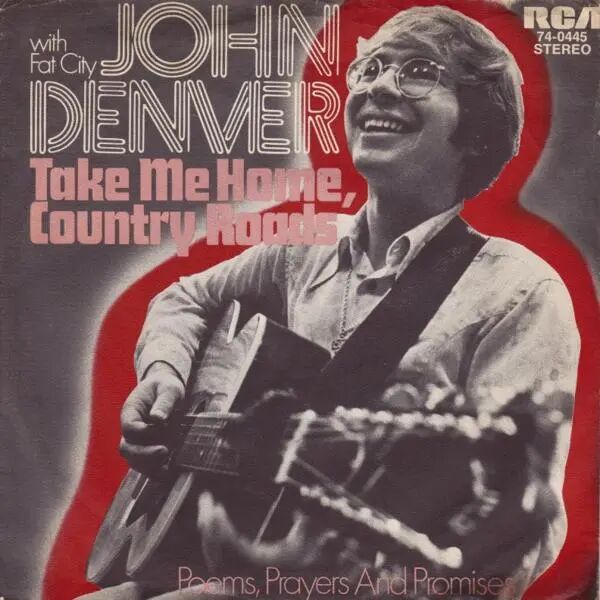
“Take Me Home, Country Roads” was released in 1971. It turns 55 this year. Chinese media call it the American version of “Boundless Oceans, Vast Skies,” a song by Hong Kong band Beyond. The comparison captures the spectacle of a stadium singing together, but not the song’s real significance. “Country Roads” has crossed three or four generations, reaching stadiums, pubs and classrooms in dozens of countries. It even made its way to China before the reform and opening-up period. Its connection to China runs much deeper than you might think.
It is a song about a home that never existed
John Denver was the most popular country singer in the United States in the 1970s and ’80s, known as “the poet laureate of Colorado.” He recorded more than three hundred songs, but the one closest to people’s hearts was always “Take Me Home, Country Roads.” His slightly husky voice sounded like a wind blowing down from the mountains as he sang about the Blue Ridge Mountains, the Shenandoah River and an almost heavenly place: West Virginia.
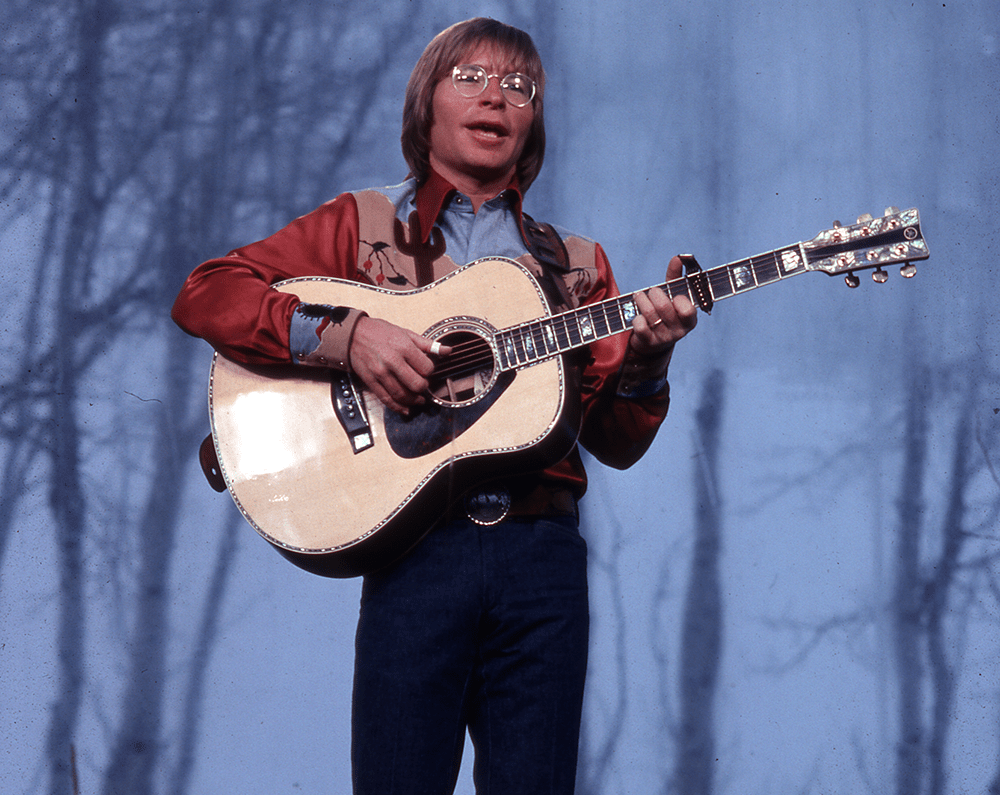
But the lyricist barely knew West Virginia when he wrote about it so lovingly. Bill Danoff, the primary writer, later admitted that his inspiration was a country road in Maryland, not West Virginia. He was simply looking for the right words. The song was originally meant for Johnny Cash. One night, Danoff played it for his friend Denver, who immediately said, “Let me record that one.” The next night, Denver gave the song its first performance in a Washington bar, holding a sheet covered in lyrics. When he finished, the entire crowd stood and applauded for five minutes. It was December 30, 1970; the next day was his twenty-seventh birthday.
And so a song about going home was born, even though its creators had never been to the “home” it celebrated. The chorus’s most important word is belong: it describes a kind of spiritual settling, the feeling of “I belong here,” of being securely held in a place. Because the song’s “home” is like an empty glass into which anyone can pour their own nostalgia, it reached stadiums around the world—from football games at West Virginia University to Munich’s Oktoberfest, from Manchester United’s Old Trafford to rugby grounds in Japan, karaoke rooms in South Korea and Seattle in 2026.
But the song’s longest journey was the one that took it to China.
A cassette tape opened a door
In 1972, Richard Nixon visited China. According to the BBC documentary John Denver: Country Boy, he brought a cassette of “Country Roads” as a gift. This was when China’s door had just cracked open, and the song slipped through that gap. It is amusing that Denver may not have been grateful for the gesture. In 1969, when Nixon first took office, Denver recorded a song called “The Ballad of Richard Nixon.” It lasted four seconds and was silent from beginning to end. A singer who mocked a president with four seconds of silence had his song turned into a state gift by that same president. History can be funny like that.
Seven years later, the door opened wider. In January 1979, Deng Xiaoping visited the United States—only twenty-eight days after China and the U.S. formally established diplomatic relations. President Carter arranged a welcome performance at the Kennedy Center in Washington. John Denver was among the performers, and he sang “Rocky Mountain High” for the guest from the East.
After the song, he addressed Deng Xiaoping in the audience:
Mr. Vice-Premier, it is with great joy that we welcome you to our country, and it is with true love that we extend our very best wishes to you and your people, on your “New Long March Toward Modernization In This Century”. Hui tou jian!
Mr. Vice-Premier, we welcome you to our country with great joy, and offer our sincere best wishes to you and your people on this new Long March toward modernization in this century. See you again!
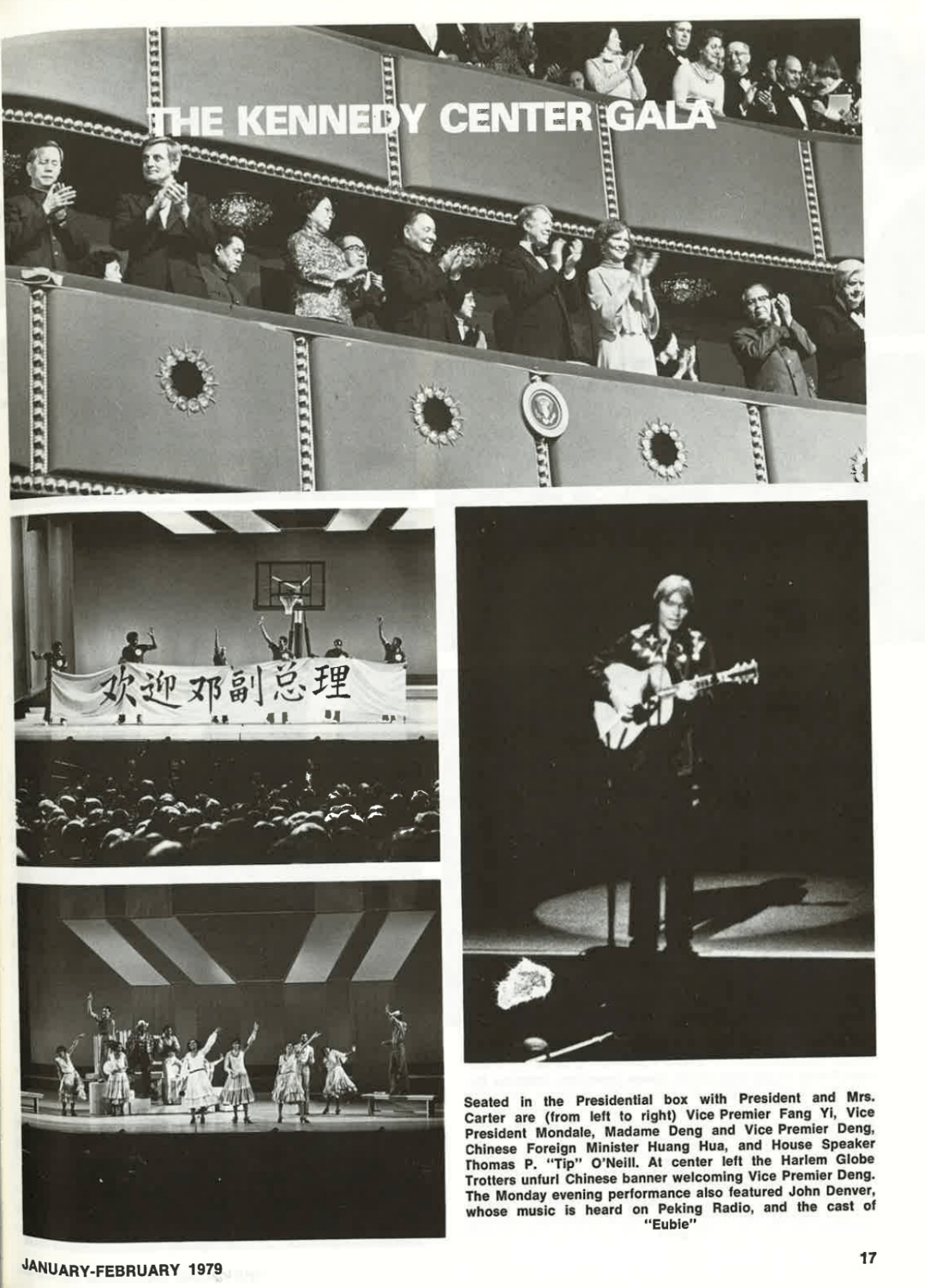
The last three words, “Hui tou jian” (“See you again”), he said in Chinese.
“See you again”—and he did
In the early 1980s, Denver came to Shanghai and wrote “Shanghai Breezes” on the spot. The title says Shanghai, but the song is about missing home. Standing in the night breeze of a foreign country, he misses his wife across the ocean. He sings that the moon and stars are the same, that her voice in his ear is like heaven, like the breeze blowing through old Shanghai at that moment. On the other side of the world, what still comes out of his pen is the oldest longing of all: I want to be back with you. Released in 1982, the song became his last hit on the American charts. The final high point of an American singer’s career carried the name of a Chinese city in its title. 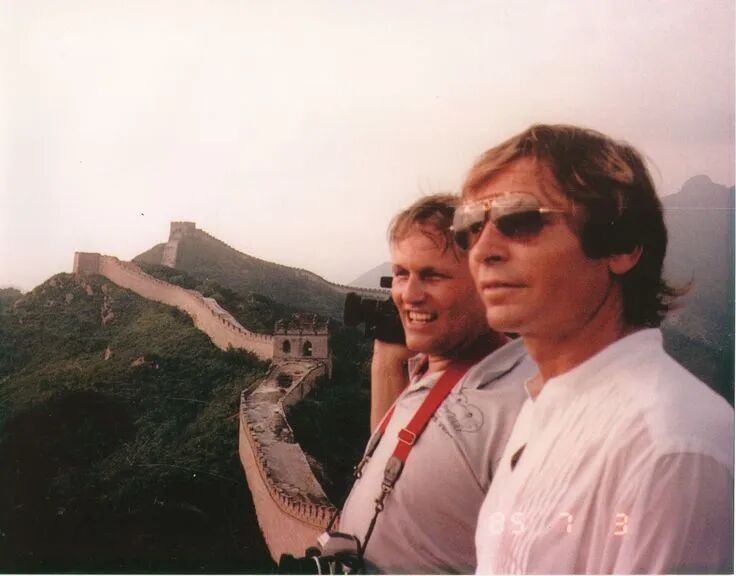 John Denver and musician Roger Nichols (composer of several Carpenters hits) at the Great Wall
At heart, Denver was a musician who traveled the world through song. In 1985, he became the first American singer in years to tour the Soviet Union; even the Iron Curtain of the Cold War could not stop his guitar. In 1994, he became the first American artist to perform in Vietnam after the war. But the place he returned to most often was China.
In October 1992, Denver came to China again. This time it was an official tour: he performed for nearly a month in several mainland cities, becoming the first Western singer to tour multiple cities in mainland China. The shows were broadcast nationwide by China Central Television. The most moving moment came when he sang “On the Faraway Prairie” in Chinese—a classic song Wang Luobin had rescued from Western folk music. His pronunciation was imperfect, and the land was unfamiliar, but he was still singing about longing and distance.
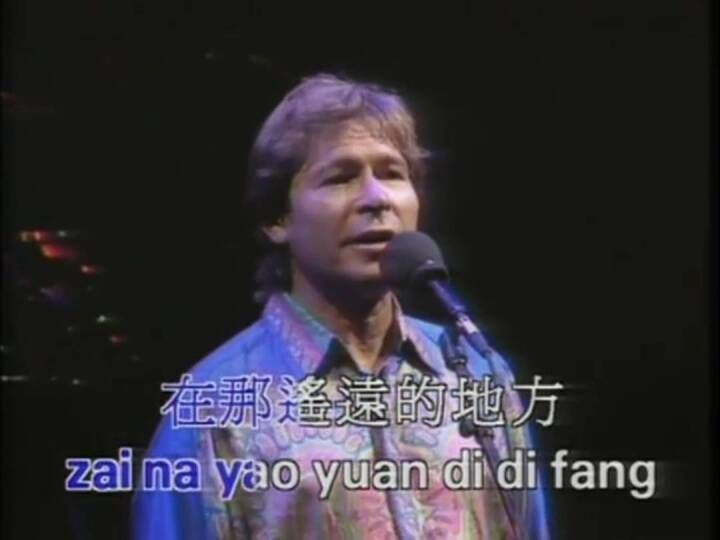
📹 The video is in the original post; the image above is its cover. Watch it in the original WeChat post
From the “see you again” he said onstage in 1979 to the many times he actually came back: the man who sang about roads and going home all his life found the same feeling of belonging in a country where he did not speak the language.
Perhaps the American song Chinese students know best
By the time Denver toured China, audiences were already familiar with his songs. After the reform and opening-up period, radio broadcasts, imported cassettes and records brought home by the first students sent to the United States helped Denver’s music take root on Chinese campuses in the 1980s. Later, foreign teachers in China noticed something: “Country Roads” was almost the one American song every Chinese student already knew how to sing.
This was no accident. China was going through an unprecedented migration in the 1980s. Tens of thousands of young people left their hometowns for the cities, while the first state-sponsored students crossed the Pacific into a completely unfamiliar world. When they heard “Take me home” in a dorm room abroad, the longing that rose in them had nothing to do with West Virginia. It was their own homesickness: the arcades of Guangzhou, the alleys of Chengdu, the birch forests of Northeast China.
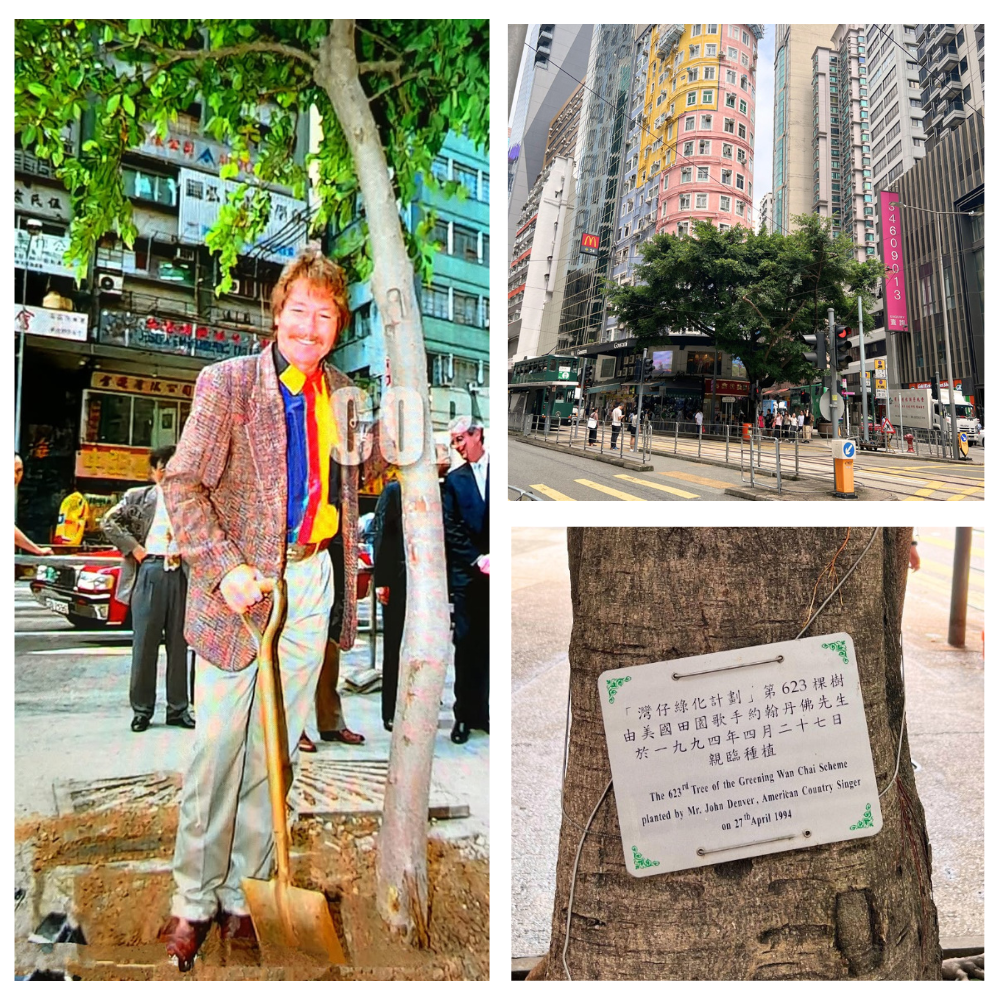
The banyan tree John Denver planted in Hong Kong’s Wan Chai in 1994, now grown into a leafy tree
Together with the Carpenters and the Eagles, whose music also arrived in China around the same time, the song became part of a generation’s earliest memories of Western pop. But “Country Roads” traveled farther than their songs because it is so easy to sing. The melody is simple, the lyrics are clean, there are no obscure words, and even someone with poor English can hum along after hearing it twice. More importantly, the thing it sings about needs no translation. Every language pronounces homesickness the same way.
The same song, different homes
On October 12, 1997, John Denver took off alone from Monterey, California, in a homemade plane. A little over twenty minutes later, it crashed into the Pacific. He was 53. He had sung “Leaving on a Jet Plane.” The man who had spent a lifetime singing about country roads, faraway places and going home was finally gone, giving himself to the sky and the sea.
He once said he did not know how many ways the song had touched people, but he was grateful to have said something meaningful to them. In 2023, the U.S. Library of Congress added “Country Roads” to the National Recording Registry, alongside “Imagine” and “Stairway to Heaven.” The official reason was its major impact on American culture, but the song has long since stopped belonging only to America.
Fifty-five years later, a stadium in Seattle is singing it. So is Oktoberfest in Munich. And somewhere in a karaoke room in Guangzhou, someone is probably singing it too. Everyone is singing the same song and thinking of a different home.