What Did Teaching Mean to Michel Foucault?
8 minutes
In the classroom, Foucault was searching for his role. He did not want to become an imposing master, but neither did he like the disorder and egalitarian spirit of the post-1968 years.
Guillaume Bellon, PhD in literature, is the author of The Anxiety of Discourse: Barthes and Foucault at the Collège de France (Grenoble University Press, 2012).
This article first appeared in Sciences Humaines, May–June 2014, special issue 19, pp. 16–17.
Translation by Finikz; proofreading by Adai. First published on the WeChat account “Notes on Intellectual History.”
Foucault was torn between two needs. On the one hand, he wanted his ideas to reach as many people as possible. On the other, he saw something quite different when he looked at the public. After teaching at the École Normale Supérieure, Clermont-Ferrand, and Tunis, he headed the philosophy department at the experimental university of Vincennes, born from the fervor of May 1968 and later known as Paris 8. He never felt entirely at ease amid the revolutionary excitement and occasional disorder there. When the chance came, he left to become a professor at the Collège de France. Rereading his inaugural lecture, The Order of Discourse (1971), we can see that this position did not satisfy him completely either. He seems to have been uneasy about being treated as a “master” by the academy and the public. That makes sense for someone who saw every discourse as a kind of “police force” that controls what can be said: he did not want to become a symbol of power. This ambivalence ran through his teaching career.
How did this “anxiety of discourse” show itself?
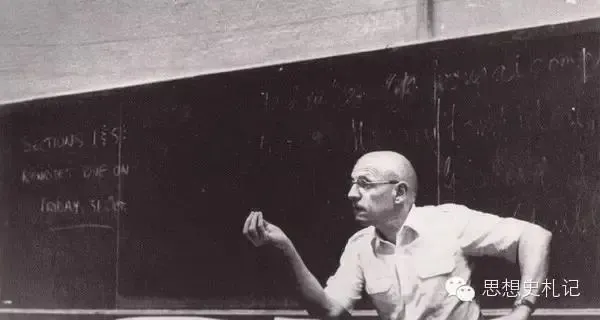
The Collège de France rules say that its lectures cannot become a “worldly event” open to everyone free of charge. Remember that Foucault was a genuine star in the 1970s: his book The Order of Things (1966) was a bestseller people took to the beach on their summer holidays. His audiences were unusually diverse and lively, and enjoyed gathering to listen, but the exchange did not always go smoothly. Foucault repeatedly tried to put some distance between his lectures and the public. First he moved them to early morning; then he organized a seminar with an entry requirement: attendees had to write a research paper and present their work. The administration reprimanded him because this went against the spirit of the Collège de France, and the old format had to be restored. From 1982, he tried a question-and-answer format for the public, but it still irritated him—for example, when an audience member addressed him informally as “you.”
Are his courses connected to his books?
We should distinguish two periods. Until the late 1970s, his lectures seem to have been largely independent of his later publications and closely grounded in the present. His interest in “the society of punishment,” for example, was directly linked to the Prison Information Group (GIP), which he had just founded. From the 1980s onward, by contrast, he increasingly drew on examples that would also appear in his later writing. His analyses of the interpretation of objects and the domination of others, in particular, responded to themes in The History of Sexuality (volumes published from 1976 to 1984). There was an interesting interruption: Foucault took a sabbatical in 1977 and then published nothing for eight years. He still dreamed of resigning and living on royalties. That ideal perhaps never came true, though he had already reached heights few intellectuals can attain.
Why did he refuse to have his courses published after his death?
Foucault’s precious manuscript archive shows how often he rewrote his texts and how exacting he was: he might rewrite an entire page just to change one word. His lectures at the Collège de France were spoken, and necessarily less rigorous. He was feeling his way, often dissatisfied with his method and starting again from scratch. His public lectures were also more or less prepared and published; he could not always deliver them at his best. In his will, he explicitly prohibited all posthumous publication, legally preventing those around him from pulling a “Max Brod on Kafka”—Brod edited and published novels that his friend had wanted burned. It takes a strong sense of purpose to organize these archives. And for the courses, editors must also decide how to turn speech into text without the author there to revise it.
Today, the courses are an important gateway to Foucault’s work
They are read more and more, and sell increasingly well. Their publishing success still surprises me, because Foucault was a demanding, sharp-edged writer, even when writing in a conversational style. I find his lectures difficult to grasp. At the same time, his work on constructing the self as an independent individual, and on social constraints, was firmly rooted in his own time—but it also speaks to readers today. His intellectual heirs have therefore reworked his legacy on their own terms and created another Foucault. That is perfectly all right. During his life, he already described himself as a “toolbox.” He embraced the idea of proposing concepts and opening paths of thought, then handing them to others to revise, reshape, and extend. Perhaps that is exactly what happened.