Not long ago, Alibaba announced it would invest 380 billion yuan over the next three years—more than it had spent on cloud and AI infrastructure in the previous decade.
Not products. Not marketing. Not R&D.
Infrastructure.
Many people saw the news and thought, “That is a lot of money.” Then they had no idea where it was going. A large share of that 380 billion yuan is going into something called AIDC.
AIDC. Four letters. Many people assume it must be some kind of protocol. It stands for AI Data Center, also called an AI computing center.
So it is just a big building full of machines?
Not quite.
An AIDC is nothing like the “server room” you have in mind
You probably know about traditional data centers, or IDCs (Internet Data Centers). Websites need to run, apps need to stay online and the Moments posts you make need to be stored. Behind all of that are rows of servers humming away in a data center.
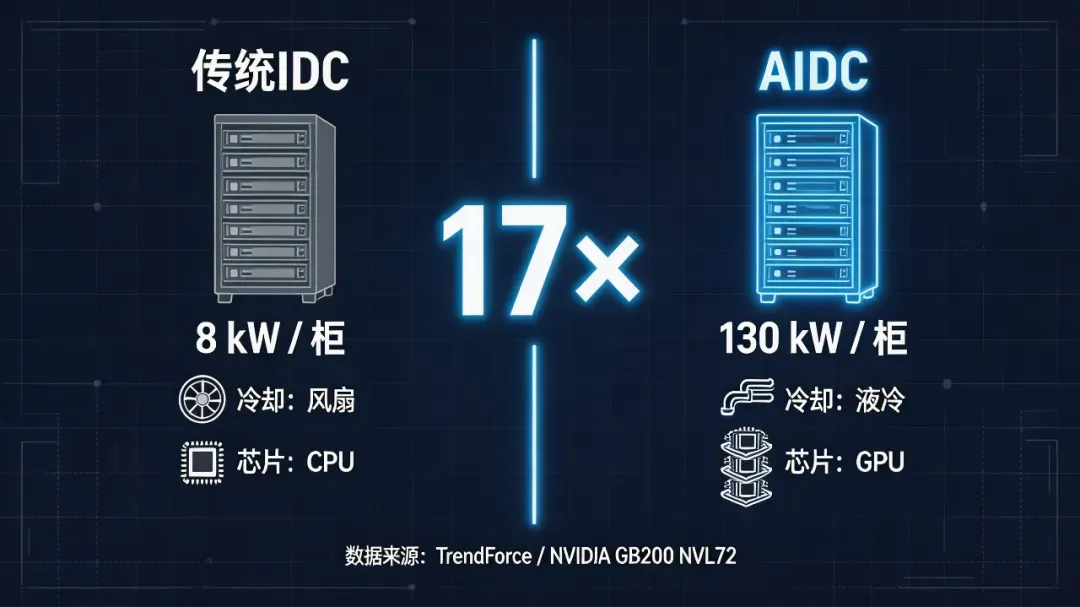
A standard rack in a traditional data center draws about 4 to 8 kilowatts. That is not very high, so fans can keep it cool. A building may hold thousands of racks, mainly running website back ends, databases and file storage. CPUs do most of the work: stable, reliable and good enough.
An AIDC works differently.
Its core is not the CPU, but the GPU. Graphics processing units were originally designed to render images for games. Then people found that GPUs were incredibly fast at matrix operations, and AI training is essentially a huge number of matrix operations. So GPUs became the engine of the AI era.
A single NVIDIA H100 GPU draws 700 watts. A full rack of GPU servers can easily exceed 20 to 100 kilowatts. The latest NVIDIA GB200 NVL72 system has a thermal design power of 130 to 140 kilowatts for a single rack, according to TrendForce.
For comparison: a traditional IDC rack uses 8 kilowatts; an AIDC rack can use 130.
That is 17 times as much.
This is not an upgrade. It is another species.
So how important is it?
In 2025, nearly every major tech company in the world did the same thing at once: they went on an AIDC-building spree.
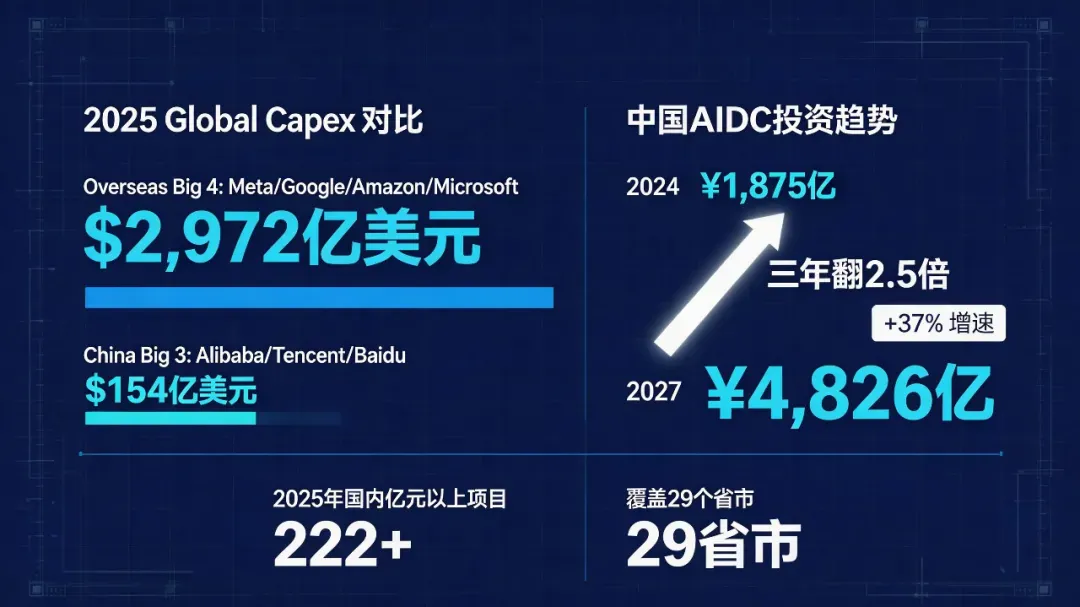
Meta, Google, Amazon and Microsoft were expected to spend a combined $297.2 billion in capital expenditures in 2025, according to the Bloomberg consensus, nearly 37% more year over year. In China, Tencent, Baidu and Alibaba together spent about $15.4 billion, up 19%.
In one year, fewer than four companies spent nearly $300 billion.
What is that money building?
Not roads or office towers. It is building the foundation for computing capacity. Large models need it for training and inference. So will all future AI applications, from asking ChatGPT a question to factory cameras spotting defective products in real time.
To put it bluntly: an AIDC is a power plant for the AI era. When you use electricity, you do not need to know where it came from. But the power plant cannot stop running.
I am getting ahead of myself. Back to the point.
In China, AIDC investment was about 187.5 billion yuan in 2024. Founder Securities forecasts that it will grow to 482.6 billion yuan by 2027—more than doubling in three years. In 2025 alone, more than 222 intelligent-computing-center projects worth over 100 million yuan each were awarded across 29 provinces and municipalities, according to OFweek.
Honestly, the pace is a little frightening. Not “Wow, that is impressive” frightening, but “Can you really keep up?” Nearly 30 provinces are digging, laying cables and installing racks at the same time. Once all that computing capacity is built, who will use it, how will it be used and will it be worth the money? No one can really say yet.
This density looks less like chasing a trend and more like catching up on years of infrastructure underinvestment—but it could also repeat the old “build first, figure it out later” cycle of bike-sharing.
What are the core technologies?
To understand what makes an AIDC expensive, there are three things we have to talk about.
First: computing power.
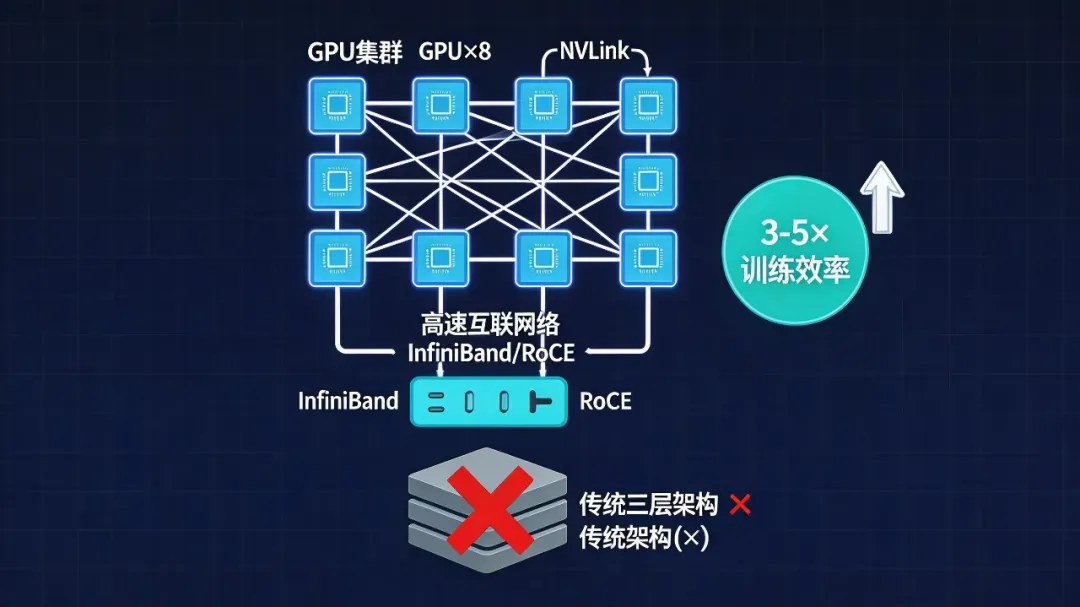
The core asset in an AIDC is its GPU cluster. Training a large model cannot be done with one GPU. Hundreds or thousands—or even more—must work together, transmitting enormous quantities of parameter data to one another every second.
That calls for an almost absurdly fast network. The three-tier network architecture used in traditional data centers cannot handle the communication demands of AI training. AIDCs use InfiniBand or RoCE technology, with extremely low latency and high bandwidth, so model parameters can synchronize between GPUs as naturally as breathing.
NVIDIA says that an AI cluster built with NVLink and InfiniBand can train models three to five times more efficiently than a traditional architecture.
Second: cooling.
How do you cool a single rack drawing 130 kilowatts?
Fans? They stopped being enough a long time ago.
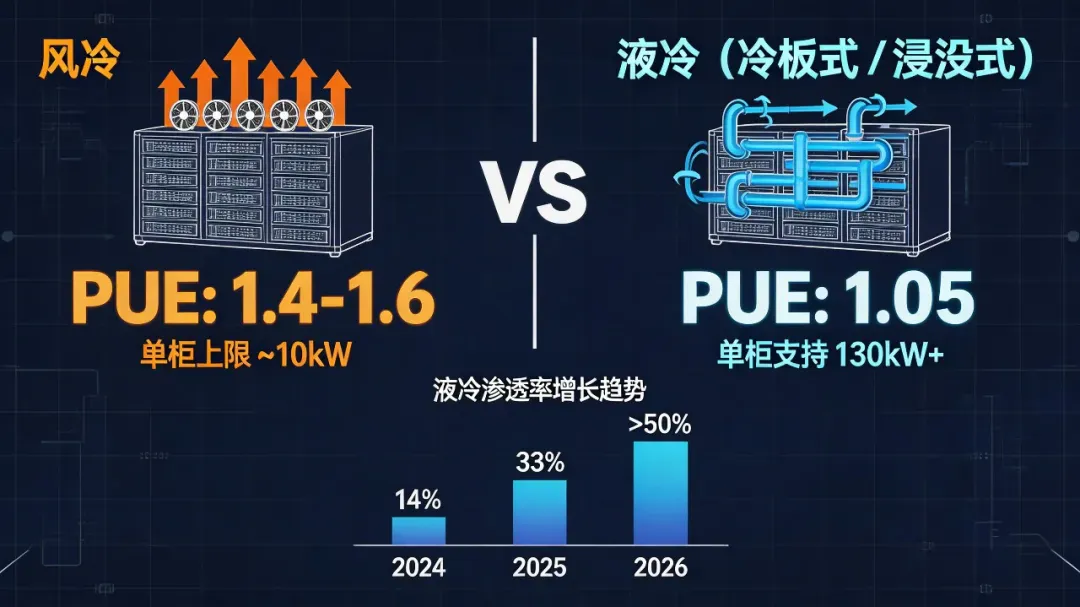
The answer is liquid cooling. There are two main approaches: cold plates, where pipes sit against the chips and carry heat away, and immersion cooling, where servers are submerged directly in a special liquid.
Immersion cooling is more efficient. It can bring PUE (Power Usage Effectiveness—the lower it is, the more energy-efficient the data center) down to around 1.05, compared with 1.4 to 1.6 in a traditional air-cooled facility. China’s Ministry of Industry and Information Technology has required new large data centers to keep PUE below 1.3 starting in 2025, a target that is nearly impossible with air cooling alone.
TrendForce says liquid cooling’s share of AI data centers rose from 14% in 2024 to 33% in 2025. It forecasts that liquid cooling will be used in more than 50% of AI servers in China in 2026.
This looks less like a normal technology upgrade and more like a revolution forced by necessity. If cooling cannot keep up, GPUs burn out, model training collapses and the whole investment goes to waste. Liquid cooling is not a bonus feature. It is mandatory.
But the liquid-cooling supply chain is currently a complete mess. Cold plates, CDUs and connectors all come in different specifications. You can buy a cold plate from one vendor and a distribution unit from another, then discover the connectors do not fit. If something breaks, every vendor says, “That part is not my responsibility.” It may sound like a small problem, but what does one minute of downtime cost at a data center? No one has clearly answered that question.
Third: energy.
This is rarely discussed, but it may be the deepest constraint on AIDCs.
A medium-sized AIDC can consume hundreds of millions of kilowatt-hours of electricity per year. SemiAnalysis forecasts that the core IT power demand of data centers worldwide will grow from 49 GW in 2023 to 96 GW in 2026, with intelligent computing centers accounting for 85% of the increase.
Find a site, secure enough electricity and connect to a reliable network. Computing, cooling and energy: if any side of this triangle is missing, an AIDC is just an empty shell.
Where does it go next?
A few directions seem relatively clear.
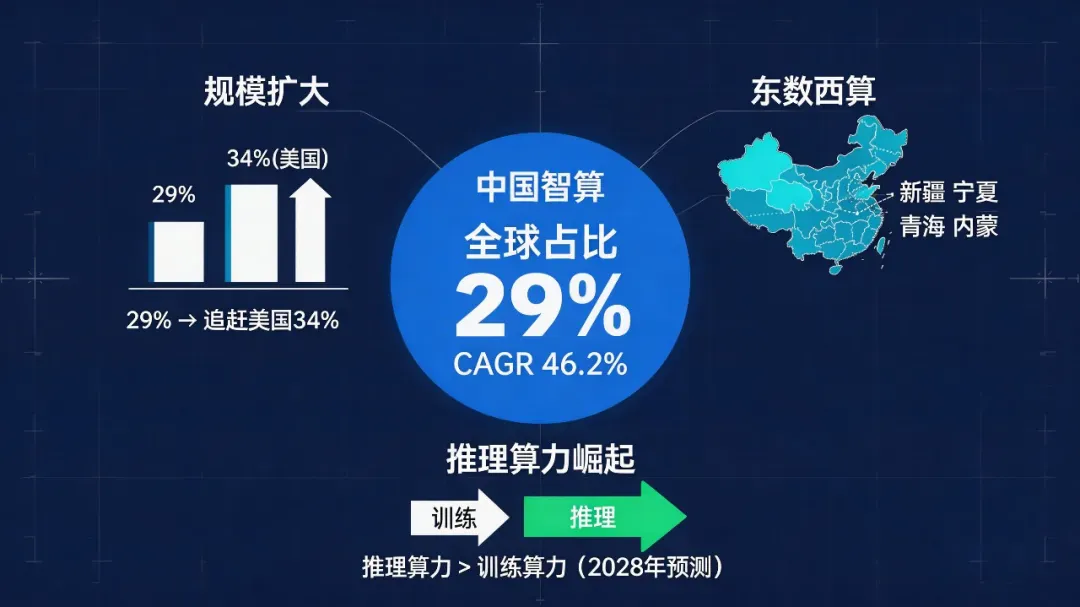
First, the scale will keep growing. At the end of 2024, China accounted for about 29% of the world’s intelligent computing capacity, behind the United States at 34%, according to IDC. China’s intelligent-computing capacity is forecast to grow at a compound annual rate of 46.2%. If that pace holds, the balance will change quickly.
Second, computing will spread geographically, following a model like “Eastern Data, Western Computing.” Computing-heavy facilities do not have to be built in coastal cities where electricity is in short supply. Xinjiang, Ningxia, Qinghai and Inner Mongolia have abundant energy resources and are becoming new AIDC hubs.
Third, inference will matter more. So far, attention has mainly gone to training compute—the power needed to train large models. But as the models mature, inference—having a model answer your questions and carry out tasks—will consume more and more computing power. Some analysts believe inference will eventually exceed training in scale. The two do not have identical hardware requirements, so the shape of AIDCs will change as well.
Of course, not every problem has been solved.
Liquid cooling still lacks standardization. Cold plates, CDUs and connectors vary by vendor, so after installation it is not even clear who is responsible when something goes wrong. Energy constraints are already appearing in some regions. Computing centers are being built, but the power infrastructure is not ready, leaving plenty of machines running idle.
In the end
Maybe this is the first time you have seen the term AIDC.
But it has quietly become a kind of infrastructure—not for the future, but for right now. Every time you talk to a large model, somewhere behind the scenes a data center is humming, coolant is flowing through pipes and GPUs are doing calculations faster than you can perceive.
The scale of global investment in intelligent computing in 2025 would have been extraordinary at any point in history.
But on reflection, maybe it is not so extraordinary.
Every infrastructure wave follows the same pattern: first people do not understand it, then they think it is expensive, and then one day it becomes part of the air—something you stop noticing because it is everywhere.
That is how electricity arrived. That is how the internet arrived.
An AIDC may be next.
The only question is how long this window will last.