Rather than distill other people, dilute yourself
Something very contemporary has been catching on online over the past few days:
Distill your colleague into a skill. Distill your boss into a skill. Distill your ex into a skill…
Someone used a “Nuwa skill” to distill Steve Jobs, Elon Musk, Charlie Munger, Richard Feynman, Naval Ravikant and even Zhang Xuefeng. At this rate, the lobster’s Axial Age is almost here…

What a person said, the decisions they made, the chat logs they left behind, their work habits and even their emotional reactions can all be collected, refined and packaged into a module you can call on. It is as if the most valuable parts of a person can ultimately be compressed into a method, a set of prompts or a more convenient stand-in that can be reused.
It sounds clever, and it certainly feels like something this era would do.
We are increasingly used to seeing complex people as sources of some “active ingredient” that can be extracted.
A colleague’s value is their workflow. A boss’s value is their judgment. An ex’s value is the emotional experience they left you with.
A person is no longer first seen as a whole person. They are more like a liquid that can be analyzed, separated, concentrated and repackaged.
But the word “distill” did not originally belong to technology alone.
It belonged to alcohol first.
And alcohol reminds us of something: distillation is never a lossless process. It can raise the alcohol content and make the flavor more concentrated, more intense and more “effective.” But that does not mean it preserves everything.
A lot gets sacrificed during distillation. The complex aromas, subtle layers and lingering notes that are hard to describe but make a drink memorable do not necessarily survive the process.
What you get in the end may be stronger.
But it may not be more flavorful.
Anyone who really understands wine knows that not every drink should be pushed toward a higher proof. More alcohol does not mean higher quality. Greater purity does not always make something more worth savoring.
What makes alcohol most fascinating is often not its strength, but its flavor; not its aggression, but its distinctiveness; not how much it hits you on the first sip, but what stays in your mouth after you swallow.
People are the same.
Thought is the same.
Today, we are far too obsessed with “refining” things.
Refine opinions.
Refine experience.
Refine methodologies.
Refine other people’s ways of expressing themselves.
Refine every part we can use immediately.
It is as if refinement makes something more sophisticated, and packaging an idea as a skill means it really belongs to you.
But often what we get is not a thought, only a concentrated extract of one. Not experience itself, but a summary of experience after it has been processed. Not the real structure of a person’s judgment, but a few conclusions that sound clever.
That is certainly useful.
But useful does not mean flavorful.
The most moving part of a person is often the part least easy to summarize and least convenient to call up. It is not what they “put out,” but why they put it out that way; not the judgments they made, but the detours they took, their lingering doubts, their inimitable taste and even their inefficient hesitation.
Those things are like the aroma in a glass of wine.
Not necessarily the strongest.
But the hardest to replace.
So I have increasingly come to feel that the question is not whether we can distill other people.
The question is why we are so eager to do it.
Because behind distillation is a desire very familiar to this era:
I do not want to experience your complexity. I only want to extract what works.
I do not want to bear your contradictions. I only want to copy your results.
I do not want to truly understand you. I only want to own a compressed version of you.
That is extreme cleverness.
It is also a very contemporary kind of arrogance.
It assumes that everything worth keeping can be taken apart and stored separately; that a person’s value can ultimately be translated into a reusable capability; that every style can be refined, every experience transferred and every thought formatted into an easy-to-share version.
Unfortunately, people do not work that way.
The things with the most flavor usually contain something that cannot be compressed.
A little impurity.
A little ambiguity.
A little untimeliness.
Even something whose value cannot be proved immediately.
Those are the parts that make up a person’s scent.
They are also what make the difference between people more than a difference in ability. It is a difference in texture.
But today’s world is encouraging something else: everyone is urged to make themselves sharper.
Sharper expression.
Sharper positions.
Sharper methods.
A sharper personal brand.
Ideally, the moment you speak, you cut through the problem; the moment you appear, people remember you; every move is high-density, efficient and certain.
A blade is beautiful, of course.
It has its own aesthetic: neat, precise, direct, drawing blood.
But when everyone is trying to grind themselves into a blade, the result is often not greater strength but greater sameness. Every blade wants to prove how sharp it is, and everyone ends up repeating everyone else from a different angle.
The cuts become more uniform. The flavor disappears.
That is why I increasingly like another metaphor.
Rather than distill other people, dilute yourself.
At first, that sounds like a contradiction, perhaps even advice to become bland, soft and forgettable.
But that is not what I mean. I do not mean weakening yourself. I mean not trapping yourself in one single, overly sharp form.
Distilling other people is extreme cleverness.
Diluting yourself is simple wisdom.
Distillation is about extracting, possessing, controlling and reusing.
Dilution is about flowing, entering, spreading and permeating.
A blade depends on its angle.
Water looks for structure.
A blade can only cut what it faces.
Water enters every crack.
A blade has boundaries.
Water does not.
The truly wise do not necessarily end up living like a blade.
On the contrary, they often become more like water.
They do not rush to prove their concentration.
They are not attached to maintaining a fixed shape.
They do not need to show their edge all the time.
Nor are they in a hurry to compress everything into a clear, standard and reproducible answer.
They know when to be sharp and when to be soft; when to concentrate and when to spread out; when to hold on to themselves and when to enter another person’s world; when to take shape and when to arrive without form.
This is not compromise.
It is another kind of strength.
Someone desperate to be defined is easy to define.
Someone desperate to be refined is easy to distill.
Only people who are not in a hurry to fix themselves in place preserve their ability to change, to permeate and to move through a complex reality.
If alcohol only chases a higher proof, it may end up as nothing but alcohol.
If a person only chases sharpness, they may end up as nothing but a function.
And the rarest thing in the world has never been function.
It is flavor.
It is the part of you that cannot be fully dismantled, distilled or easily replaced.
It is your aftertaste.
It is the thing that lingers in someone’s mind for a little while after you have finished speaking.
It is the way you can slowly enter another person’s life without trying to please everyone.
So while everyone is figuring out how to distill other people into skills, perhaps the more useful question is:
What kind of person do you want to become?
A blade that grows sharper, more effective and easier to copy?
Or a current that seems formless, yet can pass through structures, enter reality and leave a mark?
Sometimes strength is not concentration.
It is flow.
And the hardest thing to replace is not the essence that has been extracted.
It is the flavor that cannot be purified away.
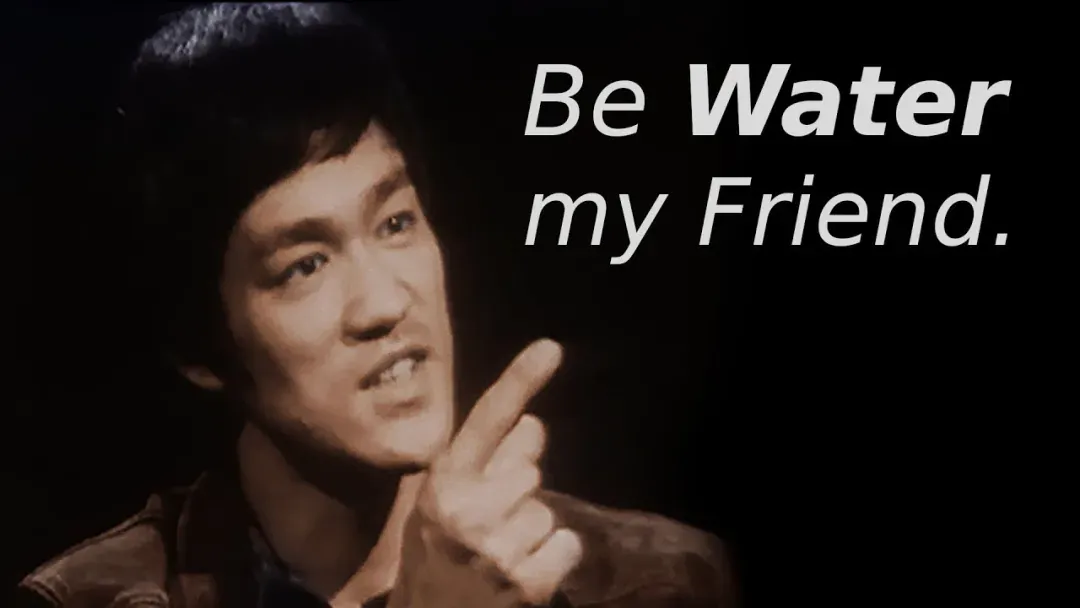
Be water, my friend.